 By
By
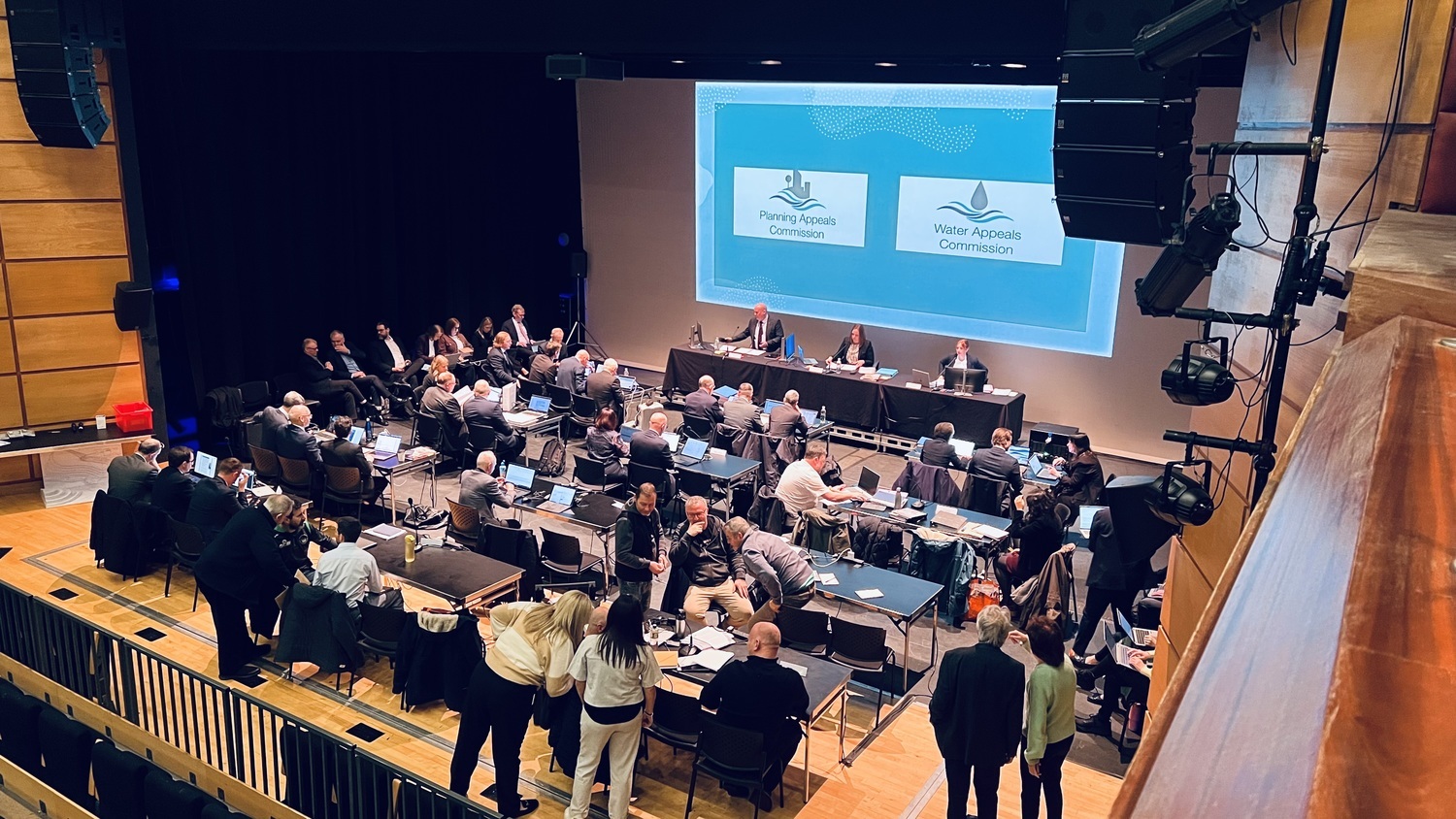
Stormont’s assessment of the economic viability of a proposed Dalradian gold mine in the Sperrin Mountains has been “misrepresented” by the company, a public inquiry has been told.
Fermanagh and Omagh District Council’s barrister, Conor Fegan, told the Planning Appeals Commission that the applicant’s representatives have continued to cite an old Department for Infrastructure economics branch report, which painted the application in a more favourable light, than a new DfI report written in 2024.
Mr Fegan warned that some of Dalradian’s submissions on the economic benefits of the mine are “not up to date” and highlighted how “submissions are repeatedly being made on” the old report while the new one highlighted a lack of detail and omissions, raised economic concerns and criticised employment data.
“Some of those statements.. no longer hold good”, he added.
Quoting from the earlier DfI report, Dalradian’s economist Andrew Hunt had said it “concludes that the project would be of substantial economic benefit to the local and regional economy”.
“It is not therefore deemed necessary that the applicant produce an updated economic impact assessment in order to provide us with further assurance”, he added.
The Department for Infrastructure was criticised by third-party objectors to the mine, on the second day of the second week of the reconvened public inquiry over its “silence” on the issue.
Third-party objector, Niall McAleer, asked “why does it come down to Fermanagh and Omagh District Council’s counsel to highlight when DfI is being misrepresented by the applicant?”
He told the Commission that the public “feel abjectly let down by the department”.
“The silence from the top table speaks volumes - how they remain silent when they are being misrepresented by the applicant is beyond me.”
US-backed Dalradian applied to mine for gold, silver and copper in the Sperrin Mountains designated Area of Outstanding Natural Beauty in 2017.
With almost 50,000 objections to the plans, the Northern Ireland Planning Appeals Commission (PAC) was tasked with leading a public inquiry, before making recommendations to the Infrastructure Minister who will decide on the application.
After suspensions in 2024 and 2025, proceedings have entered their second week at Strule Arts Centre. However, the level of detail in the proposals has been criticised heavily which has caused delays.
Third-party objectors have repeatedly raised concerns about the lack of detail, unavailable reports and outstanding assessments.
They have also questioned how the PAC can make recommendations, given these concerns.
Lack of information
Speaking for third-party objectors, University College Dublin’s Professor Amy Stryker outlined a list of missing information, including “the lack of a feasibility study and the lack of information on economic modelling”.
She also highlighted how the inquiry does not know where the gold concentrate Dalradian plans to produce for export will be processed, and that there are “no costs associated with possible failure of the mine waste facility”.
She also raised the lack of an appropriate assessment for protected habitats and a Water Framework Directive assessment.
Third party objectors Martin Tracey from Communities against Mining and Pat Haughey also pointed to the lack of detail on explosives Dalradian plans to use.
Mr Tracey said: “DfI has refused to disclose any environmental information about the explosives, the make-up or quantities. We cannot do any environmental calculations because we have been refused that data.
“The departments say they don't hold any information in regards to explosives.”
Pat Haughey said that Dalradian had said in 2024 that the explosives would cost $5m per year, but “we don’t know what form [they will take], so we don't know what impact it has on the environment.”
Speaking about the socio-economics of the project, Dr Brian Garvey from the University of Strathclyde said: “It is not clear what is the underlying analysis that is being referred to in different ways at different times that inform the socio-economic benefits.
“There’s no reason they could not have provided a full supply chain analysis,” he added.
FODC counsel Conor Fegan also raised concerns about the “incomplete” information on which the PAC and DfI would have to base their decisions.
“We have raised concerns about omissions in information and the adequacy of the information before the commission and DfI as the decision maker”, he said.
“We feel it is inadequate. Although it doesn’t reach the threshold of legal deficiency - the information is incomplete.”
Dalradian’s counsel, Stewart Beattie, did not agree with any of the assertions and said all of the information needed to make a decision had been submitted. He said they have also updated information of the economic impacts of the plan a number of times up to 2024.
When DfI counsel was asked again if the department thought the PAC had enough information to continue the inquiry, Barney McKay said the department’s position had not changed and that “there is sufficient information for the inquiry to proceed”.
He added: “If there are gaps, they can be examined as we go through the topics.”
After being pressed further by the commissioner, he added: “In relation to whether there is sufficient information for this inquiry - that doesn’t mean the information is necessarily adequate.
“That is a matter for the inquiry.”
Higher level assessments
The socio-economic questions planned were limited on Tuesday, with only two asked.
Dalradian told the inquiry their project is viable without cyanide and that even if they make just $800 per ounce of gold extracted from the Sperrins, it would be profitable.
With gold prices per ounce reaching around $4,500, there is greater potential profit if the project goes ahead. Company representatives said that gold would make up 99% of profit, with silver and copper contributing 1% or £100m over the life of the mine.
When questioned about the later inclusion of tellurium, which is vital to solar panel development, Mr Hunt said: “Tellurium has no economic value, but the government has identified it as a critical mineral. At the moment it has no effect on the value of the mine.”
Michelle Thompson, from DfI’s economics branch, told the inquiry Dalradian’s application “is one of the higher-levels of assessments that we’ve done”.
She later clarified that meant it faced a higher amount of scrutiny, but that there were no direct guidelines around this. Speaking about her 2024 economic report on the project, she told the inquiry: “I think I said I broadly agree that these benefits are plausible. I also said we don’t necessarily have enough information about the regional impact.”
Speaking for FODC, economic development expert, Keith Burge, raised issues around the lack of benefits for the local area despite the economic value of the project.
He said: “The fundamental point we were making is that during the course of this application gold prices increased significantly and with it the economic value of this project.
“But that is quite distinct from economic benefits to the local area,” he explained.
He added that “the applicant said they might not repatriate profits [to the US]”, but that
“shareholders tend to take their profits and spend them in whichever way they decide”.
Grave concerns
While the application has come under increasing scrutiny for what has been termed a ‘lack of information’ - concerns have been raised throughout both weeks of the inquiry about a tranche of documents Dalradian submitted after the Irish government held its transboundary consultation over potential impacts of the project in the south.
Lynda Sullivan, from Irish National Trust An Taisce, questioned “how Dalradian has been able to submit substantial new information as part of the transboundary consultation”.
She added: “This opportunity they were given in this unclear mechanism - this wasn’t consulted on.”
In a bid to “clarify” the situation Commissioner McParland told the inquiry a worker at a legal firm representing Dalradian Gold was “invited to submit a representation” to Ireland’s transboundary consultation after being listed as an objector on a spreadsheet from DfI.
Commissioner McParland said: “We received a spreadsheet… with a list of supporter representations…and a list of objectors. The applicant’s representative was on the objectors list that was given to us from DfI.
“In that list, there was an employee of Cleaver Fulton Rankin on the objector list. They were invited to submit a representation.”
This allowed the company to submit new documents rebutting third-party statements, which were not subject to public consultation but were accepted by the Commission.
Solicitor Mary Brolly, who represents campaign group Save Our Sperrins, said “It is shocking we learned that an employee of Cleaver Fulton Rankin represented to the PAC that they were an objector. I have grave concerns about that.”
She continued: “It does seem somewhat underhand that the procedure seems to have been circumvented for the benefit of the applicant.”
In light of that and continuing concerns over missing information and reports, she asked if DfI and the PAC were “still content” to continue and “would they not like to take the time to refer this to the minister?”
Ms Brolly described Dalradian’s new submissions as “a tactical advantage”.
“We submit that they do materially change the application before this commission,” she added.
Commissioner Cathy McKeary told her the PAC would “not be considering the application” to refer the matter to the Minister, and that the inquiry would continue.