 By
By
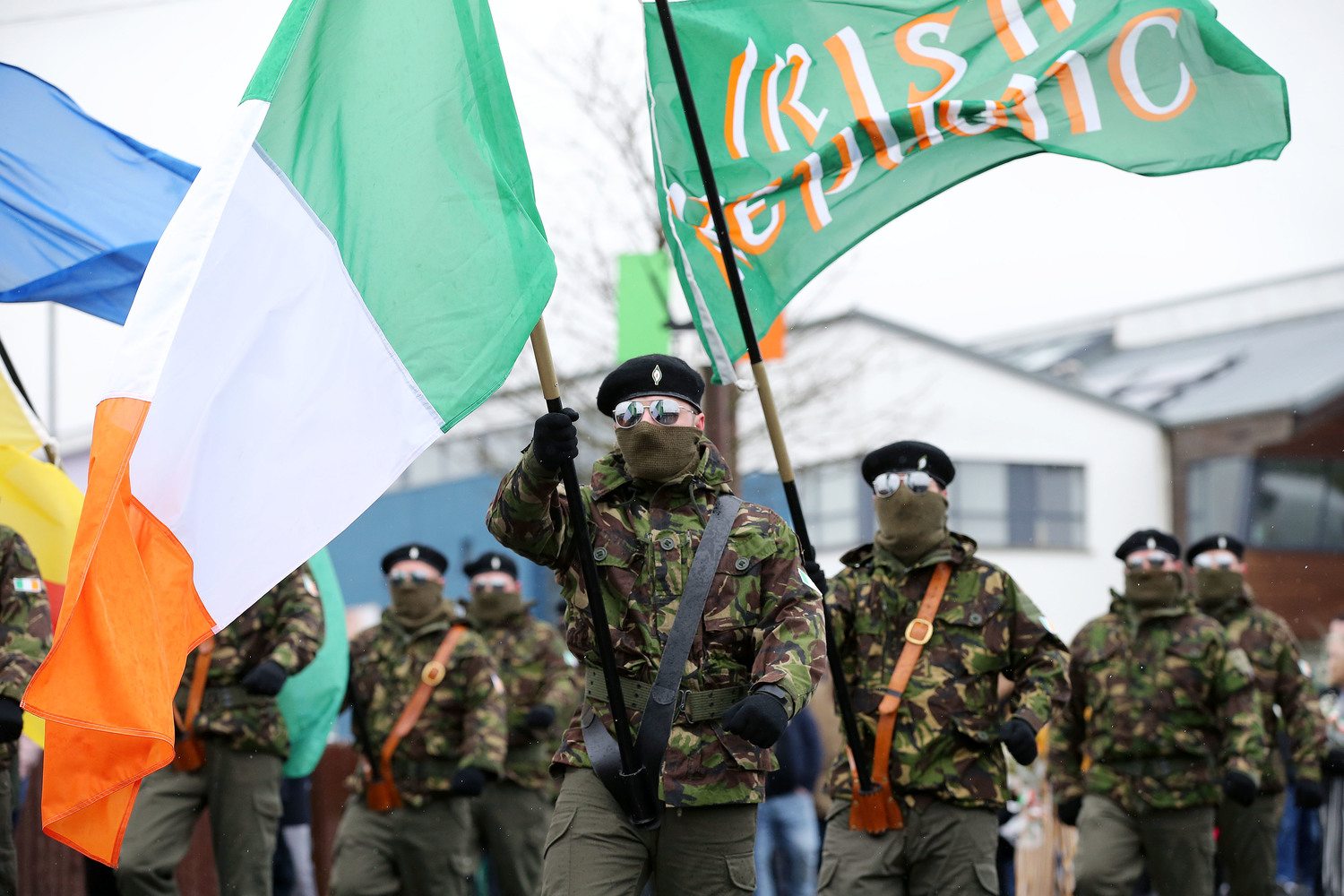
A dissident republican march in Derry. Photo by Kelvin Boyes, Press Eye
There were eight times more prosecutions of republican paramilitary displays than loyalist ones over the past decade, according to figures obtained by The Detail.
Between 2015 and 2025, there were 94 prosecutions under Section 13 of the Terrorism Act. Of those, 83 were linked to republican groups and 11 to loyalist organisations.
The figures have emerged amid renewed debate over how laws on paramilitary symbols are enforced, as the PSNI said it cannot be seen to police “more for one side than the other”.
Section 13 makes it an offence to wear, carry or display an item in public in a way that arouses “reasonable suspicion” that a person is a member or supporter of a proscribed organisation.
The offence carries a maximum sentence of six months imprisonment.
The PSNI has repeatedly come in for criticism over its approach to dealing with displays that glorify paramilitary groups.
Despite the widespread presence of paramilitary murals, flags and commemorative parades across Northern Ireland, enforcement of the law has been limited.
The PSNI has previously refused to provide information on how many people are arrested for such offences, citing the cost of collating the data.
Police submitted files on 215 individuals to prosecutors for suspected Section 13 offences during the same period.
A decision to prosecute was taken in 50% of these cases.
A spokesman for the PPS said each case was carefully considered and decisions to prosecute are taken when there is sufficient evidence to provide a reasonable prospect of conviction of the reported individual and it is in the public interest to prosecute.
It is understood that the majority of cases sent to the PPS relate to the wearing of paramilitary clothing, and cases relating to the display of flags and emblems are less common.
Each year there are many events where paramilitary clothing, flags, and emblems are displayed.
Last September, hundreds of people attended a parade in Belfast honouring UVF member Brian Robinson. A similar event was held in Portadown in August to commemorate Harris Boyle, a UVF member linked to the Miami Showband massacre. On both occasions, UVF-branded wreaths were carried in public.
Both were attended by hundreds of people, with UVF wreaths carried openly.
The UK’s most senior terrorism-law expert previously told The Detail that the “overtly supportive” displays at these events involved clear potential Section 13 offences.
“A display with the letters UVF certainly arouses reasonable suspicion that those responsible are members or supporters of the UVF, a proscribed organisation,” said Jonathan Hall KC, the independent reviewer of terrorism legislation.
“Section 13 Terrorism Act therefore applies. There are no loopholes because the display is floral, or because of clever wordplay if, in the circumstances, reasonable suspicion is aroused.”
New approach
The figures emerge as the PSNI prepares to adopt a more proactive approach to paramilitary displays.
At a Policing Board meeting last Thursday, Deputy Chief Constable Bobby Singleton outlined a new policy aimed at tackling the public display of paramilitary flags and emblems.
A new “service instruction” to officers outlining the new policy, including the direction that “not making a decision, doing nothing or failing to act is not an option”.
Some have raised concerns about how the policy will be applied.
DUP MLA Trevor Clarke, a member of the Policing Board, told BBC’s Nolan Show on Tuesday that the PSNI “would need to be consistent whenever they start their policy, because there have been criticisms in the past about how the police have policed areas”.
A statement from former MP Ian Paisley, read out on the programme, queried how “even-handed” the police would be:
“Is this a tilt to one community, that only the union flag and none republicans flagged will be removed? Mr Singleton and the PSNI will need to prove the police are consistent if they are entering on to this square.”
Last year Chief Constable Jon Boutcher announced that he was seeking additional powers to target paramilitary displays.
An amendment to section 13 will enable police to seize the flags and other articles even where the person responsible for the display cannot be identified and prosecuted.
The change is included in Labour’s Crime and Policing Bill, which is currently making its way through the House of Lords.
In response to the issues raised in this article, a spokeswoman for the PSNI said:
“Decisions to prosecute are a matter for the Public Prosecution Service and subject to an evidential test first and then when there is sufficient evidence a public interest test.
“The Police Service of Northern Ireland is fully committed to ensuring the fair, effective and legitimate safeguarding of people and property while taking action against any offenders.
She added: “We are acutely aware that public displays are a sensitive issue for our communities and we have processes in place to ensure that we act proportionately, in accordance with legal and Human Rights obligations.”