 By
By
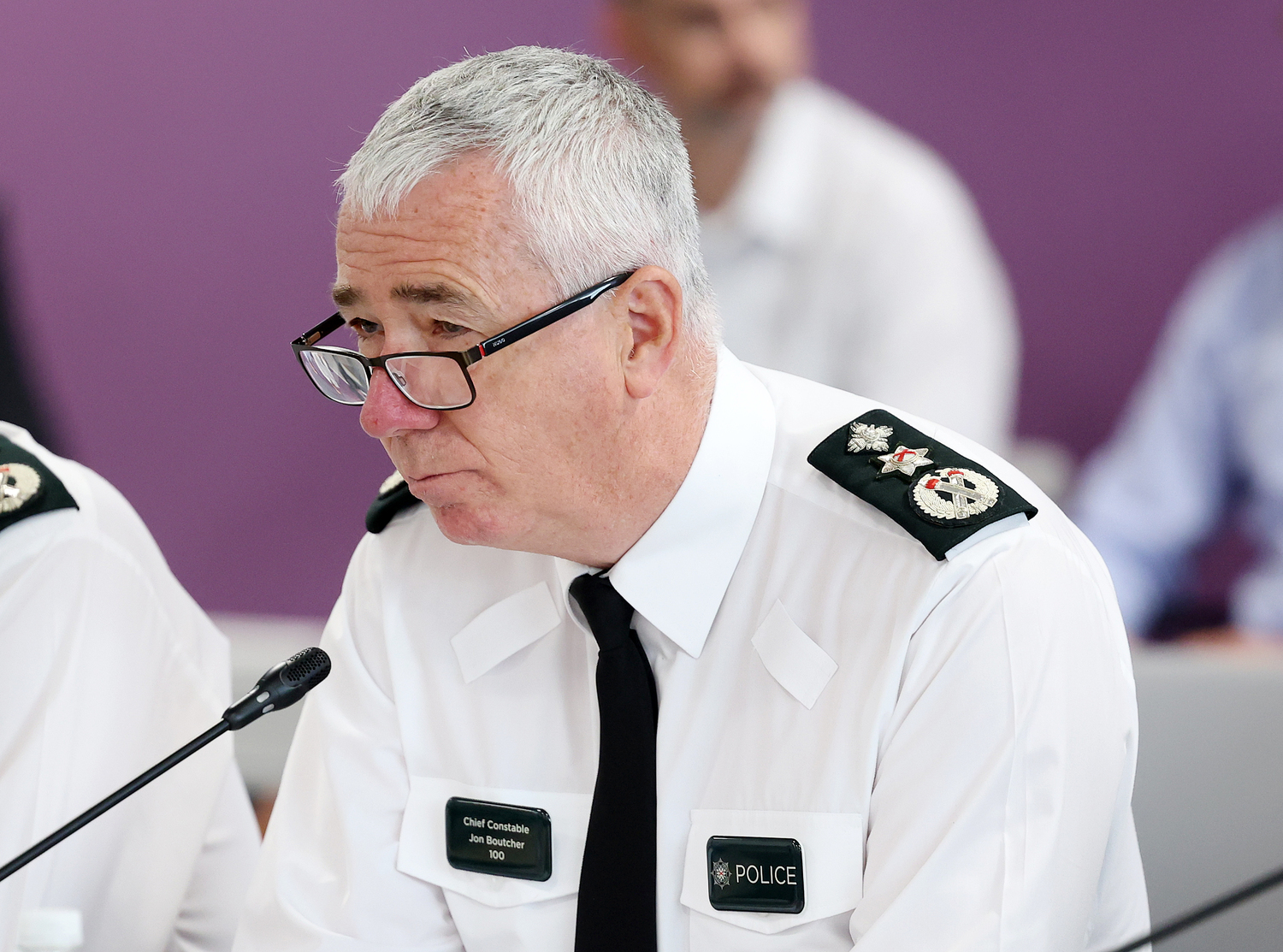
PSNI Chief Constable Jon Boutcher at a monthly public meeting of the Northern Ireland Policing Board. Picture by Jonathan Porter, PressEye
Policing costs for a proposed gold mine in the Sperrin Mountains could be up to £3 million per year, an inquiry into the plans has heard.
No official figure has been provided to the inquiry and the Police Service of Northern Ireland (PSNI) is not an active participant in the ongoing proceedings.
But estimates from third-party objectors suggest the costs could be between £500,000 and £3 million, based partly on data from some of their Freedom of Information (FoI) requests.
An estimate for policing the Currinaghalt gold mine site, where daily explosions are proposed once the mine is up and running, was not provided by Stormont’s Department for Infrastructure (DfI) nor by Dalradian Gold, the company behind the mining plans.
One third-party objector, Martin Tracey, accused the Department of being unable to deal with the “complexity” of the issues raised by the inquiry, citing a lack of clear detail over the policing dimensions of the proposed scheme and scheduling headaches.
It has emerged at the inquiry that that DfI did not ask the PSNI to be a statutory consultee at the inquiry, despite mounting security questions and the level of police resources needed to oversee the operation.
Consequently, there was significant debate about the policing and security aspects of Dalradian’s application yesterday.
One inquiry Commissioner, Cathy McKeary, asked whether policing costs “would just be about the transport and safety of magazines,” which are used to store explosive material.
Citing information he says he obtained through FoI requests, Mr Tracey told the inquiry “it would take anything up to five officers a day to be on site”.
He added that a FoI response he had received from Fermanagh and Omagh District Council “also states there’d be further costs as to protests and…they did perceive that to rise if planning was granted.”
Questioning why the PSNI had “not been pulled in as a statutory consultee to this inquiry”, Mr Tracey listed other conceivable aspects of any policing operation for the proposed mine, which is valued by Dalradian at £21-26 billion overall.
“Police must remain on site while blasting is taking place,” he said. “And that does not include the escorting.”
Another third-party objector, Fintan McAleer, says the policing operation would also have to cover transport of explosives and their detonation.
“And then they oversee the disposal of the packaging you should be burning,” he said.
“So it’s absolutely ridiculous to say that the policing would cost nothing…The cost to the public purse is a material consideration for this inquiry.”
Commissioner McKeary also asked about the proposed storage of explosives underground and whether Dalradian would pay for this.
In response, the company’s barrister Stewart Beattie said that “unless there’s a statutory basis for it, the answer is no.”
Reference was made to an unpaid £500,000 bill linked to the mine’s security costs. The PSNI had provided site security services at the facility near Greencastle, Co Tyrone, between August 2015 to June 2016.
Dalradian said at the time that they believe they and other quarry operators should be not charged for security provided for the escort of explosives, and that the PSNI has statutory legal obligations to manage explosives.
Security concerns
Third-party objectors argued the scope and nature of the policing operation would also have serious implications for security and community relations in this part of post-Troubles Northern Ireland.
One objector, Louise Taylor, described Northern Ireland as “the PTSD capital of the world, according to research”, and argued the impacts of daily blasting on the local community “should not be underestimated”.
Mr Tracey also argued the proposed mine would have serious implications for stretched local policing resources and for the area’s overall security.
He said the proposed use of explosives would likely prompt regular protests and would "dramatically inflate costs to the public purse".
Mr Tracey believes the PSNI has resisted his efforts to make public the projected costs of policing the proposed scheme. “To date,” he said, “they’ve spent £100,000 of taxpayers’ money trying to withhold an internal review report on policing costs” for Dalradian’s planned mine.
None of these concerns could be adequately scrutinised or bottomed out, he added, without the PSNI present at the inquiry – which is due to enter its sixth week.
Branding the proceedings “a farce”, he said “the community knew this wouldn’t work..that it wouldn’t be possible to get through near enough the biggest public inquiry in the history of the island in [just] 22 days.”
Clean-up costs
The inquiry also heard details of what Dalradian’s proposed restoration of the Sperrins landscape would entail yesterday.
A number of third-party objectors told the inquiry that a range of clean-up costs, including "acid-rock drainage", the outflow of acidic water from mines, were not being factored into Dalradian's application to extract gold and other precious metals over a proposed 23-year period.
As a result, they say, the costs of cleaning up the proposed mining operation would be dramatically higher than the figures the company has so far submitted to the inquiry.
One objector, Bill Donnelly, expressed his concern about the potential damage that might be caused by such outflow.
“There’s lots of evidence from America of acid-rock drainage running into mines years and years after closure,” he said.
“We could be in a situation where we’re finding acid-rock drainage in the river, profits made and the company having moved on. And the bill for sorting that mess out would be colossal. So I’d like to know whether that kind of financial guarantee is envisaged.”
Conor Fegan, a barrister appearing for Fermanagh and Omagh District Council, told the inquiry the council's understanding was that “A restoration or after-care bond would be required, should the developer fail to implement the agreed restoration plan.”
The bond, he explained, “would be drawn upon to ensure the restoration is undertaken” in the event “a developer defaulted” on its commitment to restore land post-operations.
Commissioner McKeary requested details of the bond and any repayment of this guarantee.
Responding for Dalradian, Mr Beattie told her “The closure plan is something that’s looked at and updated as required – I think it’s every three years”. He added that the bond “is not necessarily linked to the life [span] of the mine.”
John Merry, an environmental scientist appearing as a consultant for Dalradian, made submissions about the implications of dry-stack and cell restoration.
Mr Merry told the inquiry that, having looked at a “worst case scenario”, the sum committed for this would be around £3.3 million.
“We looked at a worst-case scenario, factoring in maximum disturbance,” he said. “We believe that’s more than enough to cover what would be a worst case scenario…we believe £3.3 million would be adequate for that.”
However, third-party objector, Lynda Sullivan told the inquiry Dalradian’s bond guarantee for the Sperrins site “fell catastrophically short” of what is needed, citing a number of clean-up operations in the Republic of Ireland and Spain where such costs ran into tens of millions of Euros.
She pointed to clean-up costs at mines in the Republic of Ireland that she says stand between €5 million and €60 million. One company with a presence in the Republic of Ireland was also responsible for “a mine in Spain”, she said, where restoration costs stand at “€89 million” currently.
“The Spanish state tried to get the company to foot the bill, but the company refused to and still is not.”
She added: “Toxic waste is always toxic. You can’t ‘rehabilitate’ it by putting some grass on top of it. Who’s going to foot the bill for cleaning up the waste? The toxic waste will remain here long after Dalradian are gone.”
When asked whether costs had been given for restoring soils and asphalts, Mr Merry said “We haven’t provided a breakdown of that, as it wasn’t requested at the time.”
He added: “We’d expect [Dalradian] to approach an independent engineering company. So you’d adjust the costs based on the best information available.”
Additionally, further concerns were aired over timetabling pressures. Both FODC and a number of third-party objector groups argued the lack of clear scheduling could prevent expert witnesses they have called from attending the inquiry.
This, they said, was partly because some of the experts do not live in Northern Ireland and have already had to make new travel arrangements for the postponed inquiry.
The inquiry provided a number of dates for upcoming matters to be considered, which Mr Fegan described as “welcome”. But, he said, the relatively short notice may affect the attendance of key witnesses.
“Less than a few weeks’ notice are being given” for FODC to bring in its technical witness for the water ecology who, Mr Fegan said, “will be out of the country on those dates”.
“If I have to make a formal application to protect our interests [in respect of these matters], I will have to do it.”
There is outstanding evidence that Stormont has not yet submitted to the inquiry, one commissioner also pointed out.
Commissioner McParland said the inquiry has not yet “heard anything from DfI Roads [Division]”, despite the road abandonment order sought being a significant issue, along with there being a number of other transport-related questions.
“So, they really need to step up.”
Responding to her comments, DfI’s barrister Barney McKay said: “The notion that the DfI has sought to [intentionally] delay this inquiry is one that is not accepted at all.”
The inquiry is set to resume next Tuesday.