 By
By
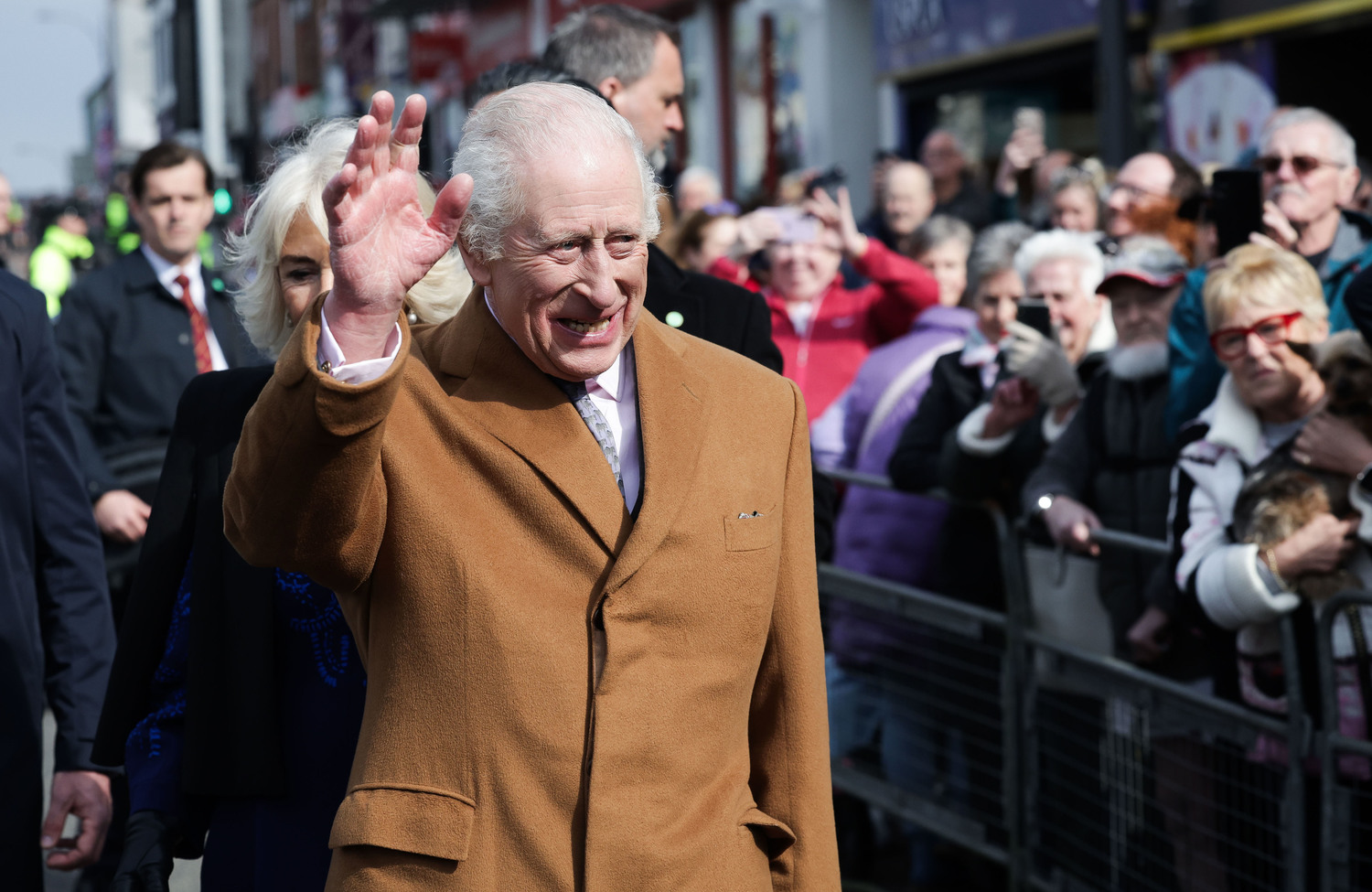
King Charles and Queen Camilla on a visit to Northern Ireland last year. Photo by Kelvin Boyes, Press Eye
King Charles’ estate would make millions through royalty payments if a planned west Tyrone goldmine went ahead, an inquiry into the proposals has heard.
Projected sales from the proposed mining scheme could reportedly be as high as £500 million per year, although this would depend on fluctuations in the price of gold.
The Crown Estate, a property portfolio worth billions owned by the British monarch, would receive 4 percent of the mine’s annual gold sales, according to an economics expert hired by the company behind the plans, Dalradian Gold.
A portion of those royalties would go to fund the royal family, which legally owns almost all gold and silver deposits in England, Wales and Northern Ireland.
An inquiry commissioner, Cathy McKeary, had asked the economics consultant, Andrew Hunt, about the specific royalty payments.
In response, he said: “The Crown Estate is being paid the royalty on the basis of the smelting…for the mineral rights, it’s a royalty for their rights. It’s 4% – the Crown gets 4%. And that’s an across-the-board percentage. It’s not for a particular smelter.”
Another royalty would go towards an Irish company called Minco Plc, which Dalradian acquired in 2017.
“There’s a separate 2% [royalty] for Minco. But that’s [now] been bought out [by Dalradian].”
The revelations came on an inquiry day during which Dalradian conceded neither it nor any other interested parties had hired a forensic accountant, a specific kind of financial expert, to scrutinise the company’s plans for a project on which it has placed a £21-26 billion valuation.
The discussion of Crown Estate payments came about through questions put to Dalradian by Commissioner McKeary and third-party participants.
Financial flows
The inquiry considered a range of economic and financial questions yesterday afternoon. Some of these questions covered the number of companies and investors involved in Dalradian’s financial structures.
Minco was one of these companies. US-based owner Orion Resources and Wheaton Precious Metals – which entered into an agreement with Dalradian for the proposed Sperrins scheme in 2023 – were also mentioned a number of times.
The Commissioner and third-party participants were seeking details of the relationships between the various companies and of assumed financial transactions between some of them.
Dalradian’s barrister, Stewart Beattie, said there was “significant confusion” about Minco’s role and about the details of royalty payments more broadly.
Beyond these more granular financial questions, there was debate over the fiscal revenues the planned goldmine would create.
Mr Hunt told the inquiry that Dalradian’s mine would generate "FTSE 100 levels of corporation tax".
But third-party objectors and representatives for Fermanagh and Omagh District Council (FODC) argued much of this tax revenue would not make its way back to the local area or to Northern Ireland.
Commissioner McKeary asked Dalradian to provide details of promised fiscal returns for the area, noting that claims of economic benefits were something “the applicant relies on heavily" to gain approval for the proposals.
The economics expert, Mr Hunt, stressed the financial benefits for the region that the planned scheme would generate. He said Dalradian did not try to lobby Stormont to set a corporation tax rate or to levy a special fiscal arrangement on the firm.
A FODC representative said these revenues were not guaranteed to flow back into the area.
"This corporation tax will go to the UK Exchequer, and the UK government can choose to do with that whatever it likes," he said.
"It can choose to spend it on defence, the NHS…or to reduce the [overall Westminster budget] deficit. There is absolutely no guarantee that money would flow back to Northern Ireland, let alone to the Fermanagh and Omagh local district.”
Skills gap
A notable point of contention was Dalradian’s promise to train and employ local people who are currently out of work.
Conor Fegan, a barrister acting for the council, argued that the company’s draft plan to train and provide jobs for unemployed local people was "long on promises and short on detail”.
But the mining company defended its proposition, citing an “action plan” it says it has developed to tackle unemployment in the surrounding district.
Mr Hunt told the inquiry he “refuse[d] to accept” that some of an estimated 1,000 unemployed people in the council area “could not be assisted into work” through Dalradian’s planned mine.
He cited large-scale infrastructure projects in Britain, including the 2012 Olympic Games and the Sizewell C nuclear facility, which he said had "exceeded targets for recruitment".
Dalradian’s economics adviser also said the company would seek to train local people currently out of work “over three years”.
“It’s about giving local people as much opportunity as possible,” Mr Hunt added.
But a representative for FODC questioned the likelihood of Dalradian's local employment ambitions being realised.
Keith Burge set out the area's skills gap and challenges to rapid workforce training. “A very significant proportion of people who are unemployed or economically inactive have low levels of qualifications,” said Mr Burge, leading him to question the feasibility of Dalradian’s training claims.
He told the inquiry that a significant number of these people were suffering with health problems, were students, had care responsibilities or were retired.
“These are not people who, in most cases, are able or willing to retrain and gain qualifications allowing them to work, respectively, at this operation.”
Mr Fegan also questioned Dalradian’s binding obligations towards training, noting what he said was the repeated use of the phrase “‘we’ll use reasonable endeavours’” in the firm’s employment plan. “It’s not ever going to be a hard commitment. It’s only ever going to be ‘reasonable endeavours’ on this.”
Mr Hunt said “a very high level” skills gap analysis for the project and the FODC area was done and it features in the planning application for the goldmine.
“We’ve analysed the skills level both at the mine and in the local area,” he said.
“Abrupt or early closure”
Questions were also raised around the mine’s lifespan and what could happen if it closed earlier than initially forecast.
Citing a number of mining case studies in Australia, third-party objector Sean Tracey asked whether “abrupt or early closure” of Dalradian’s planned mine was a likely prospect.
Commissioner McKeary said there are a number of questions around such a scenario to which she intends to return.
Turning back to job questions, Commissioner McKeary asked whether the final five years of the mine, projected to operate for 20-25 years, would be dedicated to restoration of the landscape and what this would entail.
John Merry, an environmental scientist hired by Dalradian, told the inquiry there would first be “a one-year active” initial winding down phase. “Then, there’d be a year of active mine closure, we’d disassemble the equipment. Then, there’d be a 5-year period of post-closure monitoring.”
Mr Merry said that “a lot of the environmental staff” looking at landscape and environmental factors, including water quality, “would stay on if they wanted to.” When asked for exact numbers, he said, “You’re talking 20 to 50, depending on the [specific] phase.”
Of the mine’s overall restoration period, Mr Merry said: “There’d be significantly reduced workforce numbers for that. We’re not certain of the numbers yet”. He noted that the roles Dalradian envisions for the restoration phase of its scheme are at an “outline” planning stage currently.
Concluding the day’s session, Commissioner McKeary said: “We’re slightly more than halfway through.” She added that the inquiry is still to hear submissions on carbon monetisation, social impacts, policing, community, distribution, and socio-economic considerations.
The inquiry continues.