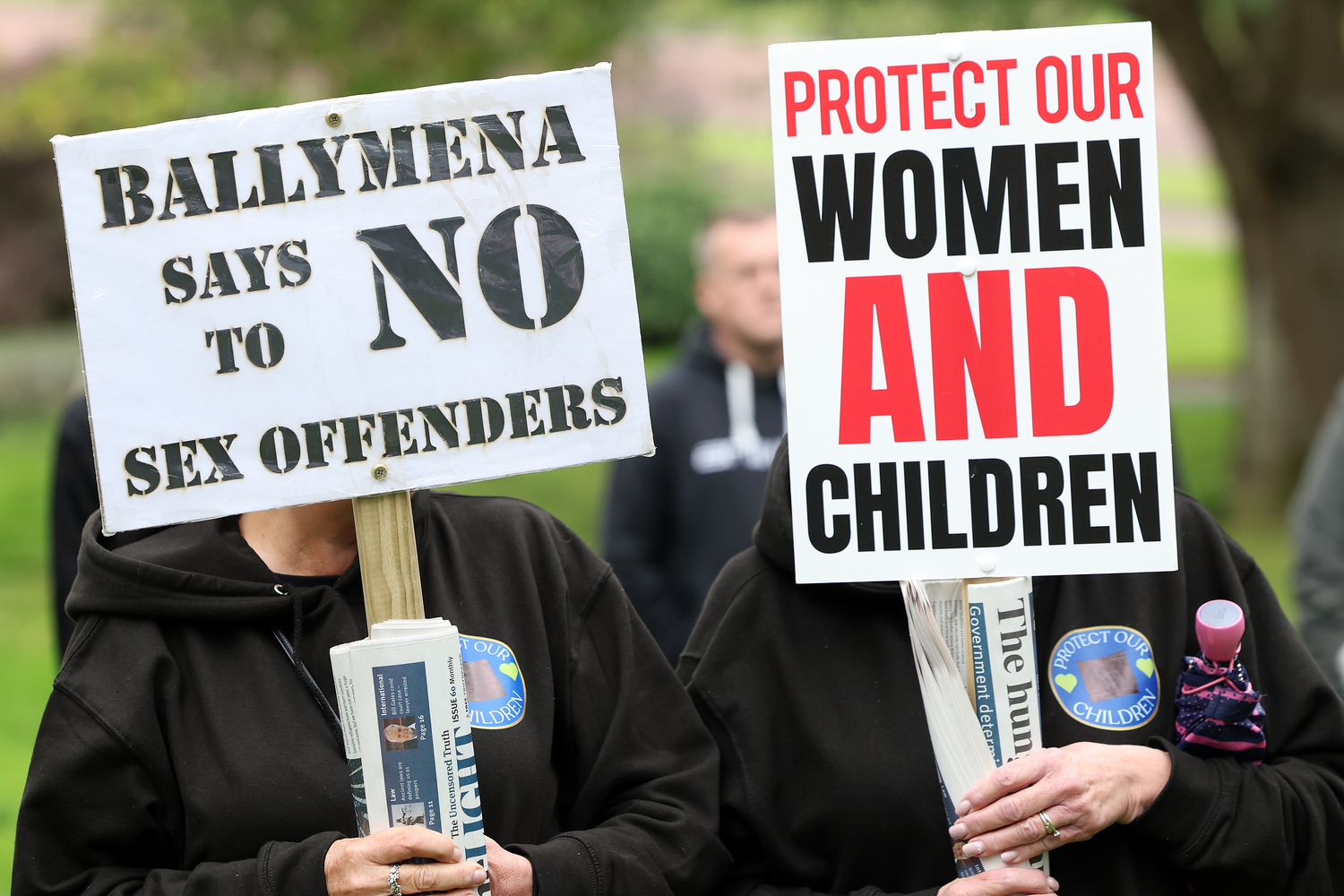
Police data from the past three years has consistently shown that a significant number of those arrested for their involvement in racist violence across the UK also had a history of domestic violence.
==
One in seven of those arrested during the violent disorder that took place in Ballymena and surrounding towns in June 2025 has since been reported to the PSNI for domestic abuse.
PSNI data show that 14 of the 100 people arrested were reported for domestic abuse in the 13 months following the riots.
The figures were released to The Detail following a freedom of information request.
The rioting in Ballymena was sparked following protests over an alleged sexual assault of a teenage girl by two 14-year-old boys who spoke in court through a Romanian interpreter.
The Public Prosecution Service later dropped charges against both teenagers, citing “significant evidential developments” in its decision.
The Detail previously revealed that a third of those arrested in connection with the Ballymena riots had been the subject of a domestic abuse report before their involvement in the disorder.
Of those arrested for participating in the riots, a third were aged under 18. Police data indicates that minors are statistically rare perpetrators of domestic abuse, accounting for less than 4% of cases annually.
Several hundred people took part in multiple days of violent disorder in Ballymena which spread to neighbouring towns and saw the homes of ethnic minority families set ablaze and 107 police officers injured.
Martin Alan Kerr, 41, used a metal pole to smash the window of a police car during the violent disorder in Ballymena. He was initially charged with riot, before having this downgraded to assault, and was sentenced to six months' imprisonment in November.
At a court hearing prior to his sentencing, a judge refused Kerr’s request for bail, noting it was "wholly unrealistic to apply for bail to live in the very town that you were accused of being involved in significant racial rioting."
By March 2026, Kerr had been released and attempted to assault a woman, damage her property and make further threats to damage her property. He has been convicted of one count of threats to damage property and one count of attempted criminal damage and is now subject to a two-year restraining order.
Patterns
Police data from the past three years has consistently shown that a significant number of those arrested for their involvement in racist violence across the UK also had a history of domestic violence.
Megan McClure, from the Women’s Resource and Development Agency, said that "the attempt to frame racist violence and anti-immigration sentiment as a response to concerns about violence against women and girls is both deeply harmful and fundamentally dishonest.
“Violence against women and girls (VAWG) is overwhelmingly perpetrated by men known to victims, within families and communities, yet far-right actors repeatedly seek to redirect attention towards migrant and minority communities. In doing so, they exploit genuine public concern about women's safety to advance racist and divisive agendas.
“The events in Ballymena demonstrated how adroit the Far-Right have become at hijacking the ending VAWG narrative to promote hostility towards migrant communities. Not only does this cause direct harm to those targeted, it also distracts from the real work required to prevent male violence and support victims and survivors,” McClure added.
Speaking at the Northern Ireland Affairs Committee in the week following the Ballymena riots, Zoë McKee, the PSNI’s Head of Public Protection, explained that on each day of the disorder “there was a review of resources and a surge out to support front-line policing,” with specialist officers often extracted to provide this support.
McKee noted that during this disorder women and children were probably disproportionately “being forced from their homes and having crimes committed against them as a result.”
Further data released by the PSNI to The Detail indicates that at least 67 Officers of Sergeant & Constable rank were extracted from the Public Protection Branch to engage directly on matters related to the riots over a 12-day period.
The total number of hours recorded on this duty was 2778 hours (or 347 days based on a standard 8-hour shift).
The PSNI’s Public Protection Branch handles serious and complex cases, which include adult safeguarding, child abuse, domestic abuse, sexual violence, and is involved in the monitoring of sexual and violent offenders.
PSNI data for 2025/26 indicates that there were 31,558 domestic abuse incidents recorded in the past year, with the force dealing with a domestic abuse-related call on average every 17 minutes.
Police data from 2024/25 shows offenders are most likely to be white (96%), and also most likely to be UK or Irish nationals (90%).
The violent disorder that took place in Belfast this June, where families were burned out of their homes in targeted arson attacks and police deployed water cannons against rioters, meant this was the third summer in a row that race riots had taken place across Northern Ireland.
More than a quarter of those arrested for participating in this disorder are under the age of 18, and the Children’s Commissioner has highlighted cases of children with paramilitary drug debts being ferried to take part in rioting.
Despite similar concerns of children being coerced into violence during the Ballymena riots, documents provided to The Detail under FOI laws show that the PSNI did not make a single referral to the government mechanism used to identify victims of child criminal exploitation.