 By
By
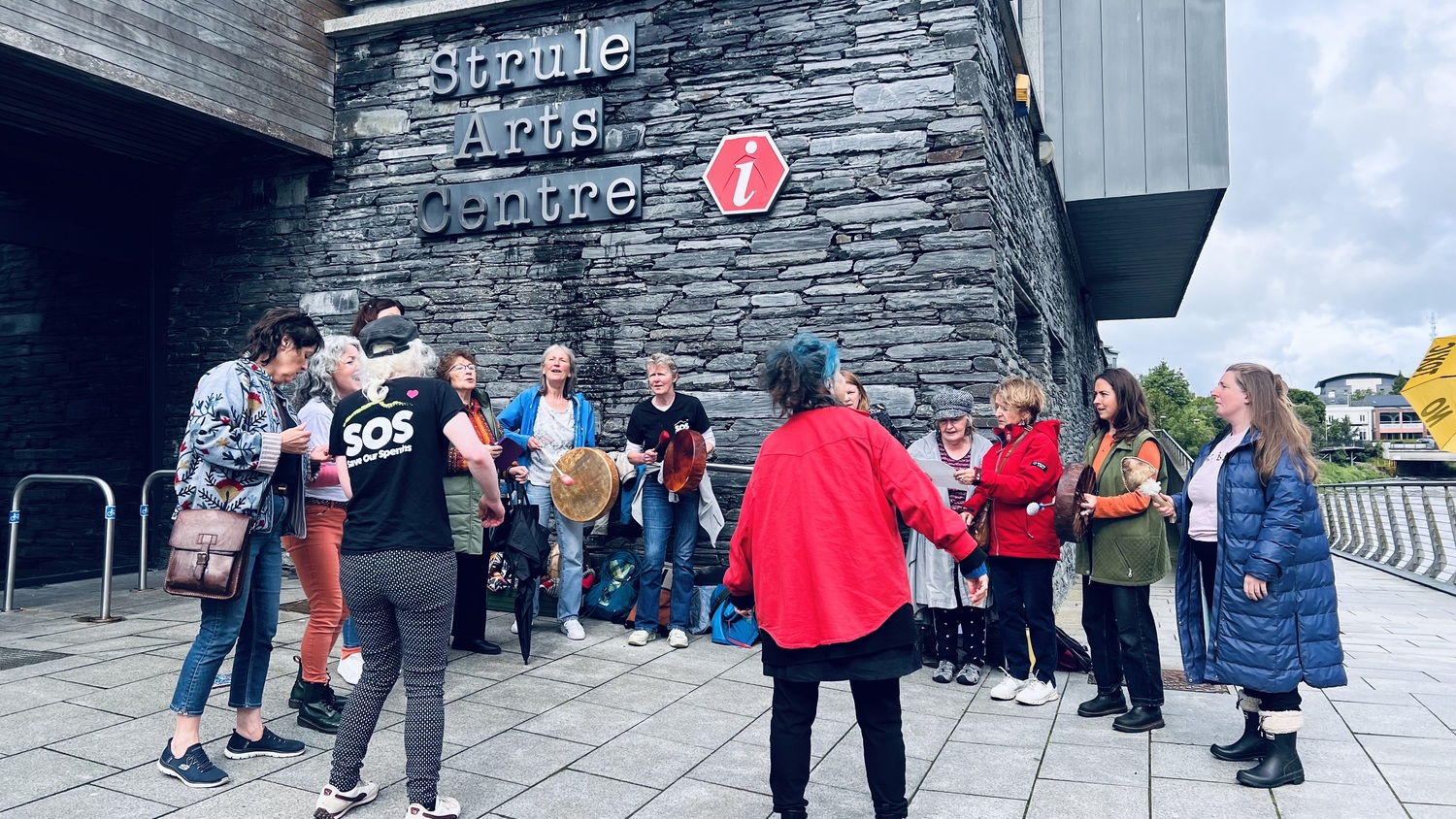
Protestors opposing the goldmine outside of the Strule Arts Centre in Omagh, where the public inquiry is taking place. Photo by Shauna Corr
Experts appearing for a cross-border water preservation body told a public inquiry that the adverse impact of a proposed goldmine in the Sperrin mountains “is so great” that it “can’t be lawfully permitted”.
The Loughs Agency, established as part of the Good Friday Agreement, said it had identified a series of deficiencies in submissions by Dalradian Gold around waterways and protected species.
Richard Honey, counsel for the agency, said that to approve the application in its current form “would be unlawful”.
If Dalradian secures permission to mine gold, silver, copper and other metals over a period of 20 years, it would leave behind up to 5.8 million cubic metres of waste rock in an area designated for its natural beauty. This will be stacked over 50 metres high on top of excavated peatland and a stream that supports a range of protected species.
The company’s application includes requests to discharge a range of potential pollutants into local rivers. The list contains harmful substances including lead, mercury, and arsenic.
Public inquiry proceedings were almost derailed last week when the Northern Ireland Environment Agency (NIEA) revealed the draft discharge parameters it had produced for the inquiry “contain errors” and would have to be redone.
Liz Smyth, principal scientific officer in NIEA’s regulation unit, said their data contained “a mixture of inconsistencies across different parameters”.
An exasperated Commissioner McParland voiced concerns she would be considering the water discharge applications “in an information vacuum”.
Despite the missing data, which could take two weeks to produce, both the Department for Infrastructure (DfI) and NIEA said they wanted the inquiry to continue. DfI counsel David Elvin suggested new parameters could go out to public consultation after the inquiry closes.
Third-party objectors raised a number of concerns about the missing data. Dr Elaine McGoff from An Taisce said “it bamboozles me” that at this stage of a public inquiry such vital information would be missing.
Dr Amy Strecker, an environmental law expert at University College Dublin, said the purpose of the inquiry was “not to facilitate this application going through”, but “to robustly scrutinise the applications”.
Dalradian’s counsel, Stewart Beattie, said his client’s position is that they are aligned with UK conservation standards in relation to water discharges “with the exception of nitrates”.
Lough Neagh
Submissions over eight days highlighted how waterways which are already breaching environmental targets could be further impacted by the mining firm’s plans.
There are already widespread concerns about nitrate pollution in Northern Ireland’s waterways, including Lough Neagh, where excess nutrients from agricultural, sewage and other sources has contributed to devastating blue-green algae outbreaks since 2023.
Dalradian Gold plans to use 44,000 tonnes of ammonium nitrate explosives across the 20-25 year lifetime of its proposed mine, and has applied to discharge nitrates into waterways.
The inquiry heard last week how “nitrate residue” from an approximate 16 blasts a day will come into contact with groundwater if the mine is flooded post closure.
But farmer and third-party objector, Martin Tracey, raised concerns the nitrates in explosives could impact aquifers that provide drinking water much sooner. He said: “This isn’t 25 years down the road, this will start as soon as they start blasting. It will be washed into the aquifers.”
NIEA’s biodiversity branch lead, Richard Grey, said his department has “concerns about the nitrate levels too” in terms of fish and molluscs the government is required to protect. He said the agency is aware levels are already too high to conserve freshwater pearl mussels in the Owenkillew River, while background levels are also rising in Owenreagh. Both rivers are downstream of waterways that will be impacted by Dalradian’s proposals, and are designated for protection.
Marella Fyffe, chair of campaign group Save Our Sperrins, said “we only have to look at the ecological disaster at Lough Neagh to know what it looks like when too many nutrients find their way into our waterways”.
“Surely after Lough Neagh, we cannot keep treating nutrient pollution as somebody else’s problem further downstream. Stop asking how much pollution a river can carry and start asking why are we adding more in the first place?”
However, Mr Beattie for Dalradian told the PAC the “endemic political failure” to tackle nitrate pollution in Northern Ireland “does not mean other schemes must be refused”.
He argued that “the problem with nitrate is farming and forestry - those are the elephants…That is why the river systems are failing.
“There seems to be a lack of political will to fix it,” he added.
Chernobyl
The inquiry also heard that radioactive material that fell in Northern Ireland after the 1986 Chernobyl disaster could be disturbed by mining in the Sperrin Mountains.
Dalradian Gold hopes to mine thousands of tonnes of metals from the Sperrins, removing hectares of peatland to make way for mining facilities and a waste dump.
But one expert claimed that “it is impossible” to prevent radioactive material stored in Sperrins bogs since Chernobyl “from being mobilised” if the peat is moved.
A radioactive cloud passed over Northern Ireland following the disaster, leading to restrictions on farming until 2000, and until 2012 in parts of England and Wales.
Dr Lee Klinger, a peatland and forest ecologist, made the comments during days dedicated to scrutinising the mine’s potential impacts on water ecology.
“Removing peat, or digging into it, could mobilise the dormant historical contamination and it could go into the local waterways,” he added.
However, the Northern Ireland Environment Agency said levels of caesium-137 have fallen significantly since Chernobyl and are now well below regulatory thresholds. It said studies of similar contamination in Scottish peatlands found no realistic risk to human health.
Robert Hill, an expert speaking for Dalradian, said the levels of caesium-137 were so low that “the risk posed to the environment is not subject to regulation”.
‘Contention and division’
Clergy whose parish churches could be impacted by a goldmine were refused permission to speak at the inquiry in Omagh last week.
Fathers Brian Donnelly, Roland Colhoun and James Devine wrote to the Planning Appeals Commissioner outlining a series of concerns about the proposed mine in August.
The trio attended the inquiry dressed in their clerical collars, but when they raised a hand last Tuesday it went unanswered. Two of the priests returned on Wednesday in a second attempt to give evidence which was refused.
Up to now the commissioner has usually addressed requests from members of the public to speak personally.
It is understood the priests sought to talk about potential impacts Dalradian’s plans to drain ground water, surface water and peatland could have on the earth beneath their church buildings and cemeteries.
The priests had previously written a letter to the PAC on August 18, which outlined how the mine “could devastate the Catholic faith community” in the area.
They said they had "always maintained a neutral position regarding Dalradian’s proposed mining operation” because “mining has become a source of contention and division” within their parish.
They added, however, that the project also had the potential for "untold emotional and psychological distress" to bereaved families if loved ones' graves are put "at risk of disturbance or collapse".
The earliest grave at St Mary’s in Rouskey dates back to 1824, while the foundation stone for St Patrick’s Church, Greencastle was laid in 1840.
The letter also outlined concerns about the impact mine blasts could have on their churches, adjoining graveyards and Our Lady of Lourdes primary school in Greencastle. They requested a one mile exclusion zone around all of these sites to “ensure the integrity of our sacred spaces”.