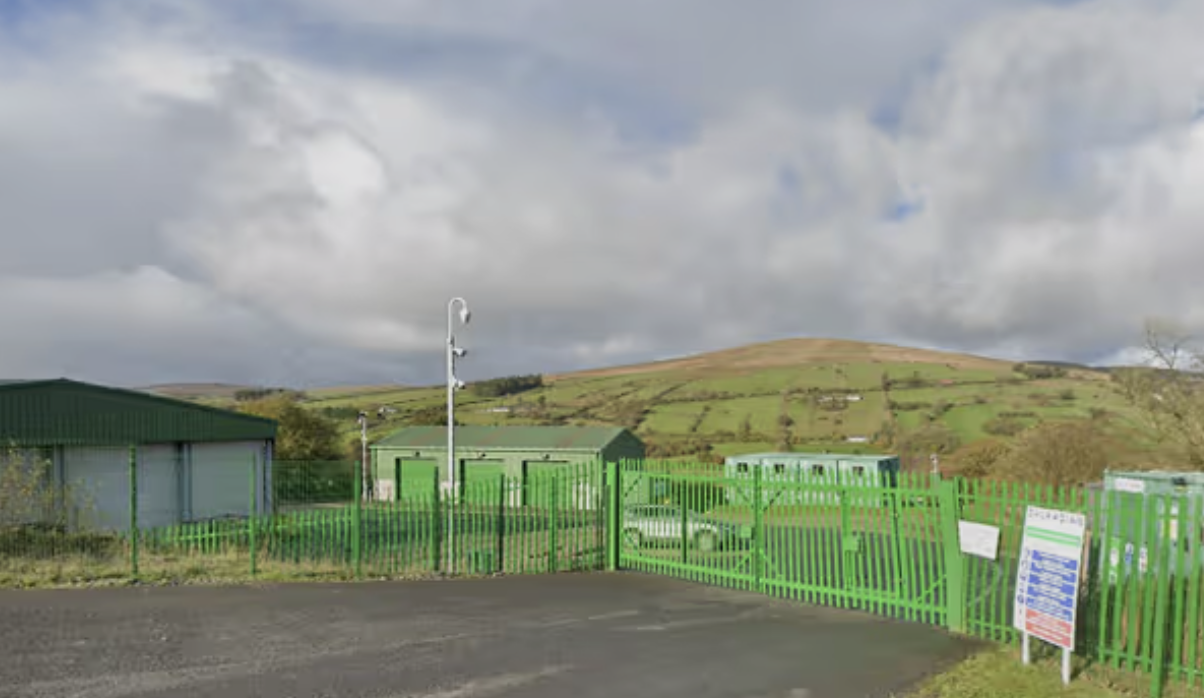
The public inquiry resumed this week after collapsing last year. Photo of the Camcosy Road site by Shauna Corr
A US-backed company seeking to mine gold in the Sperrin Mountains operated “in breach of planning control” for years over a “temporary” exploratory site it failed to restore, a public inquiry heard on Wednesday.
Dalradian Gold applied in 2017 to mine gold, silver and other precious metals in the Sperrins designated Area of Outstanding Natural Beauty over 25 years - resulting in 50,000 objections and a local public inquiry.
Four years earlier it applied for planning permission for “temporary buildings, vehicle parking, waste rock storage area, water treatment system and passing bays” as well as an extension to an existing underground tunnel in 2013 for a site on Camcosy Road in Co Tyrone.
Because that application was deemed “temporary” it meant no environmental impact assessments were carried out before the now defunct Department for the Environment permitted the extension of a mining tunnel and buildings, including a facility to store explosive materials, in 2014.
The firm was supposed to return the site to its original greenfield condition several years ago - but did not - which led to enforcement action by Fermanagh and Omagh District Council (FODC) last August.
Dalradian’s legal counsel, Stewart Beattie KC, told the PAC: “The intention had always been to retain the structures until this process had completed.
“I don’t think anybody in the room thought ten or nine years after lodging the planning application, we would still be here now.”
A third party objector and former FODC councillor, Emmet McAleer, said: “You could argue that they avoided the more stringent EIA applications because it was a temporary approval.”
The company has appealed the council’s enforcement over its failure to restore the site at Camcosy Road, Greencastle - that case will be heard separately by the PAC.
It also submitted a new planning application for Camcosy Road’s retention up to November 2026, after withdrawing a previous application because it was going to be refused.
As well as the lack of EIA assessment on Camcosy Road, the 8,500 tonnes of infill - which is effectively waste used to level out ground for building - added to the site was raised again.
FODC’s counsel Conor Fegan had been asked on Tuesday to provide the council’s view on the infill issue on Wednesday morning. He advised the inquiry that Dalradian’s “enforcement notice does not require the removal of any infill” from the site.
Third party objector Pat Haughey disagreed, saying: “The original planning application said it should be restored to its original state - the original state did not include infill.”
Cormac McAleer from Save Our Sperrins added: “Nothing said this morning changes the reality of the unauthorised infill at that site.
“I understand the position Fermanagh and Omagh District Council has been placed in because it is between Dalradian and the department [for Infrastructure].
“The splintering of responsibility on many environmental control systems certainly [seems] in favour of the applicant.”
‘Unfair advantage’
Regardless of the infill issue, Conor Fegan KC said: “There is a breach of planning control in failure to restore the site.”
He told the Planning Appeals Commission it would also need to consider whether Dalradian has had an ‘unfair advantage’ in relation to the Camcosy Road site, which it is now hoping to retain in its application for a full mine.
This he said, would mean the “retention of unauthorised works” and that if planning permission was granted for the mine - “as things currently stand, it would retrospectively authorise the breach”.
He said while the temporary Camcosy Road site was not environmentally assessed, the 25-year mine project has been and that to compare the two was “comparing very different things.”
In UK planning law, an ‘unfair advantage’ can refer to where an applicant gains an improper benefit, bypasses standard procedures, or acts against the public interest in securing permission.
“You have to reach a clear view on unfair advantage,” Mr Fegan told the PAC
“If you reach the view there is an unfair advantage then that acts as a legal bar to granting planning permissions.”
Mr Beattie, for Dalradian, said: “We don’t accept that there is an unfair advantage as we are still pursuing our legal rights.”
He added that it was his view the environmental statement for the new application is satisfactory in terms of Camcosy Road. He added that the company would “act accordingly” in relation to PAC findings on the separate case about their planning breach.
Mr Fegan rebuked: “For some time Dalradian has been operating in breach… They could have complied with the requirements of the conditions.
“The applicant is responsible for ensuring they comply with the planning conditions of their permission - not the council.”
DfI’s legal counsel, David Elvin KC, weighed in to say he has “difficulty with Mr Fegan’s submissions” about the Camcosy Road site.
He added: “This is not unauthorised EIA development - it only becomes EIA development when it is incorporated into the project.”
Mr Fegan responded by saying: “I hope DfI keeps an open mind because they have expressed a very firm position there.
“DfI is being asked in the context of the application [for the full mine] to give permission to an unauthorised part of that application - that is an error of law.”
Third party objectors also raised concerns. Martin Tracey highlighted how the case examining Dalradian’s appeal against FODC enforcement has faced long delays at the PAC.
He said: “[It] sat with the PAC for three years and the PAC had to admit maladministration.”
Pat Haughey said the Camcosy Road site “cannot be accepted as part of the main project for several reasons”. He added that the consents for the site “were only temporary” and that exploratory “works were to cease and the site was to be restored to a greenfield condition”.
“The reason there wasn’t EIA was down to the temporary nature of the site.”
Cormac McAleer added: “I am concerned about the understanding of the department [DfI] about environmental regulations.”

Gold ore in a shed on Dalradian's Camcosy site in 2016. Photo by Shauna Corr
Cyanide
Following concerns on Tuesday that cyanide is still referenced in the mining application, DfI’s Mr Elvin distributed print-outs of a proposed planning condition to allay public fears.
A planning condition sets out the rules in relation to any given permission, but such conditions can later be challenged or varied.
The condition read: “No cyanide or cyanide-based compounds shall be brought onto, stored, handled, used or disposed of anywhere within the application site at any time, whether directly or indirectly”.
Save Our Sperrins solicitor, Mary Brolly, said they were “suspicious” of the cyanide condition proposed by DfI in relation to the mining application.
Third party, Mr McAleer told the PAC it appeared “what we are witnessing is an opportunity for documents to be tidied up and amended… to make the application more palatable.”
Another third party, Martin Tracey, added: “It should have been the appellant that put forward these papers because… it is their application.
“In regards to… cyanide being removed - should the document not be coming from them rather than the actual department? I think the department [DfI] is plugging the hole for them to keep them right.”
Commissioner Jacqueline McParland responded, saying the condition set down in front of third parties was in response to “concerns” about cyanide.
“We have asked the appellant and the department to explain why there remains references to cyanide. The department has said it believes it can be satisfied by condition. The appellant supported that.”
Questions were also raised about why DfI had penned the condition and why Dalradian has not produced papers outlining how it will not be used. This led to further uncertainty around new information being allowed into an already ever changing planning application.
Ms McParland said: “If a proposal came from the applicant that they wish to submit a new chapter, I would be saying ‘no’. That does not include what DfI does after the inquiry.
“The commission does not have any say in what DfI does.”
It was agreed that the condition would be discussed at a later date to allow people time to consider what it contains.
Conflict of interest
Another issue raised was the perceived conflict of interest posed by environmental consulting firm Golders Associates working for both Dalradian and later the Department for Infrastructure.
Commissioner Jacqueline McParland sought opinions from those gathered, leading to calls for submissions on further alleged ‘conflicts’ involving politicians on both sides of the Atlantic, the PSNI, a DfI director, political advisors, and even the King’s Lord Lieutenant of Tyrone.
The PAC said they would return an answer on Monday on whether further submissions can be made in regards to other perceived conflicts of interest.
Golders Associates, which is now part of global engineering and consultancy company WSP, reviewed Dalradian’s mine waste management plan for DfI ahead of the public inquiry.
The company also worked for Dalradian between 2011-2017, on various projects including tailings tests, audits and professional services relating to a waste license exemption.
Save Our Sperrins (SOS) submitted that work on the same project for both a decision maker and applicant constitutes a major conflict of interest.
SOS member, Fidelma O’Kane said: “We perceive a severe conflict of interest that Golders worked for Dalradian from 2011-2017 and then were contracted by DfI on a £300k contract to assess the very waste dump that they had done tailings tests for.”
Dalradian’s Mr Beattie didn’t see a problem. He said a High Court judge had said the claim was “arguable”.
He was told by Martin Tracey “I don’t think the judge stated it wasn't arguable, he said it would be better discussed at the public inquiry”.
Commissioner McParland said she was aware and that was why she had asked the question.
The public inquiry continues on Monday in Omagh.
Commissioners outlined how they got through around half of what was planned this week and warned it is likely to go well over schedule.
Subjects yet to be discussed include economic viability, trade and exports, market volatility, public revenues, displacement and leakage, employment skills, carbon monetisation, policing, mine closure and social impacts on tourism and agriculture.
Shauna Corr is an investigative reporter