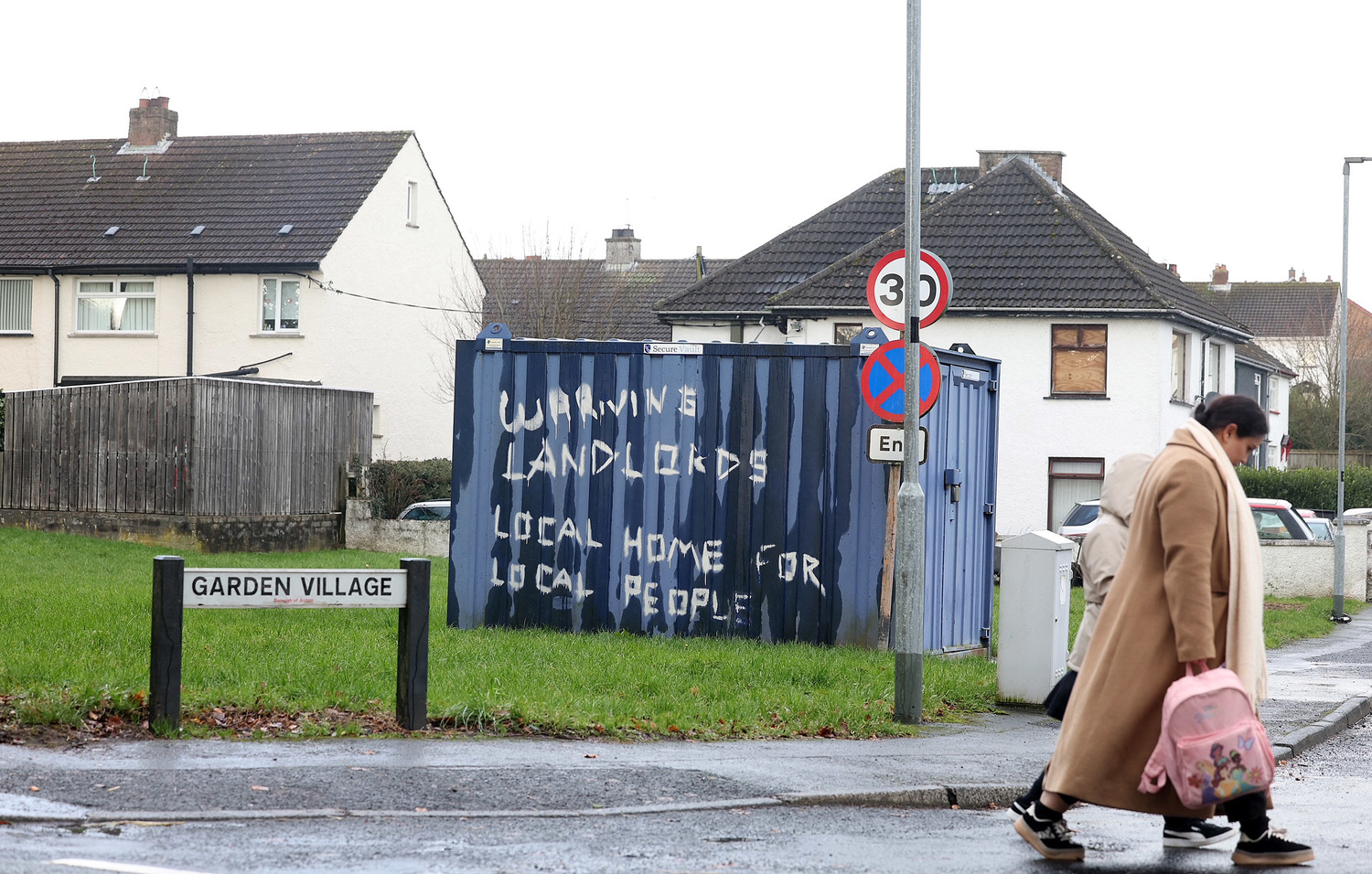
Racist graffiti in the Ballycraigy area in County Antrim earlier this year. Photo by Press Eye
Migrant rights groups across Northern Ireland are being targeted by far-right organisations, according to a new report by the US-based Human Rights First (HRF).
HRF spoke with dozens of activists, immigration service providers, and lawyers, all of whom detailed a targeted campaign of intimidation, including death threats, graffiti, and online harassment.
Some organisations said they no longer publicly advertise their services as a result of the targeting.
The report—which calls on the Northern Ireland Executive to “publicly acknowledge” racist violence in Northern Irish institutions, as well as the participation of paramilitaries in organised anti-immigration movements across the region—comes nearly one month after racist riots took place in Belfast.
Last month one account on X shared a list of what it claimed were the names and addresses of immigration lawyers, and encouraged “patriots” to “do with that what you will,” according to the report.
For organisations like Migration Justice Project at Law Centre NI, the impact of the campaign has been wide-reaching: “We consider carefully whether we as individuals want our names publicised on our websites and social media, as we are aware that lists of immigration advice practitioners have been shared online in the past,” Róise McCann, a policy and research officer, told HRF.
Other lawyers told similar stories.
“Fewer people are taking up these cases because they’re not well paid, they’re complicated, and there is now the risk of attacks which are scaring more people off,” Sinead Marmion, the chair of the Immigration Practitioners’ Lawyers Group, said. She described the increase in anti-immigrant threats as an “onslaught” against migrants and the lawyers who represent them.
“I’m more careful now about who I tell what I do, and I’m guarded in public,” Ms Marmion told HRF.
The rise in threats has caused organisations like the Law Society to remove a once-publicly available list of immigration law practitioners, which included names and contact information, due to safety concerns. After the recent riots, the Law Society went so far as to remove the search function that directed users to practitioners from their website.
Groups concentrated on Facebook have been the driving force for much of the hate proliferating online, though abuse on X has been similarly impactful to the organisations.
But the intimidation campaigns have gone beyond the virtual world. Takura Makoni, a policy officer at the African and Caribbean Support Organisation in NI, told HRF that he had faced death threats, and his home had been targeted with hateful graffiti after he reported racist signage in his area to the PSNI.
Landlords who rent property to migrants have faced similar harassment: Sam Carson, a Ballymena landlord, told the BBC that he and his Filipino tenants faced an “online hate campaign,” detailing posts accusing him of aiding illegal migrants and listing him and his tenants addresses online.
And while the recent riots in Belfast may have further inflamed tensions between the far-right and immigrant rights groups, such organisations have witnessed a steady rise in threats and harassment for years.
In October of 2025, a report by Law Centre NI found that immigrant rights organisations experienced a significant drop in engagement from migrant communities following a wave of racist campaigns.
But organisations operating within loyalist and working-class areas—especially in regions that are still under the sway of loyalist paramilitary organisations like the Ulster Defence Association (UDA) and the Ulster Volunteer Force (UVF)—have felt the brunt of such campaigns.
“Anti-migrant mobilisation has offered [paramilitaries] an opportunity to reframe themselves as ‘protecting’ local communities,” End Deportations, an anti-racist organisation based in Belfast, stated in the report. “Today, the targets are migrants and people of colour rather than Catholics, but the methods are familiar: burning homes and forcible displacing people, setting up roadblocks, organising large shows of strength, and relying on the implied threat of weapons even when guns are not openly displayed.”
According to the report, the Northern Irish government has relied on migrant-centered organisations for years to provide services where they fell short, such as in housing, education, and employment. Despite this dependency, many of the organisations lack both funding and structural support amidst the rise in attacks.
“Community groups, migrant-led organisations, lawyers, churches, trade unions, and volunteers have stepped in where statutory support has fallen short, often while facing intimidation themselves,” the report stated.