 By
By
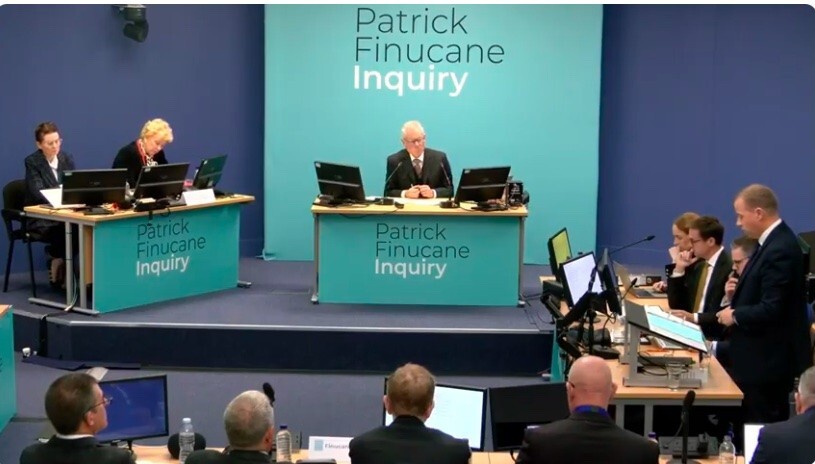
The public inquiry into the murder of Pat Finucane is being prevented from access to millions of intelligence documents because government funding for a secure computer system has yet to be agreed more than two years after the investigation was first announced.
The Detail can also reveal that a key post to be filled within the inquiry is being recruited and will be employed by the Ministry of Justice – rather than the inquiry itself.
In addition, that key post, which deals with the management of classified intelligence material, remains vacant, more than six months after being first advertised in March.
The significant issues in the disclosure of sensitive materials to the Patrick Finucane Inquiry (PFI) emerged as the investigation began its first public hearings, 37 years after his family first raised concerns of state collusion in the killing.
Counsel to the Inquiry, Alex Jamieson, told a hearing earlier this month that his legal team had “no consideration of any closed or secret material” and that, as a result, he did not yet know what information the secret intelligence materials might contain in relation to the solicitor’s 1989 murder.
Funding
It has now emerged that the inquiry lawyers’ inability to access secret intelligence documents relating state agencies’ roles in the Finucane murder is because government funding has not yet been approved to allow the PFI to operate secure computer system facilities to properly scrutinise confidential MI5, PSNI and British army documents.
Inquiry chair Sir Gary Higginbottom stated: “Until the inquiry can receive and work on documents on its own systems, capable of dealing with and processing all of the material that we may recover, progress will be slow, no matter how hard the inquiry team works.”
The Inquiry chair said he hoped evidence hearings could take place in coming months, when his legal team could cross-examine key witnesses, but warned:
“That program will be dependent upon, amongst other things, the availability of the facilities to which I’ve referred and the rate at which disclosure of documents is made.”
The PFI inquiry has now confirmed to The Detail that it has still not been given the secure computer infrastructure to allow its lawyers to handle and scrutinise sensitive intelligence documents.
Insisting that the inquiry itself was not responsible for the failure to provide its lawyers with the necessary technology to conduct its investigation, a spokesperson said:
“The Patrick Finucane Inquiry expects to handle very large volumes of classified material. With that in mind, it requires access to physical infrastructure enabling it to handle any such material securely. At present the Inquiry does not have dedicated access to this infrastructure, including in relation to IT.”
The spokesperson added: “The delay is outwith the control of the Inquiry as this infrastructure can only be supplied by HM Government and the PSNI.”
MI5
The PFI admission is significant because one of the inquiry’s central tasks is to establish the extent of MI5’s knowledge of the activities of British Army agent Brian Nelson, a senior UDA member who played a direct and important role in the conspiracy to murder Mr Finucane.
The inquiry must also determine whether MI5 and other security agencies withheld crucial intelligence documents from previous investigations into Mr Finucane’s murder.
At the hearing, Inquiry counsel, Alex Jamieson, highlighted MI5’s previous role in providing sensitive material to Operation Kenova, the investigation formerly led by Chief Constable Jon Boutcher into IRA agent Freddie Scappaticci.
Mr Jamieson outlined how MI5 had possessed a tranche of intelligence material which it had failed to hand over to Kenova investigators until after an interim report had already been published.
MI5’s late disclosure caused Kenova investigators to substantially revise their original assessment of the security service’s knowledge of Scappaticci and his activities.
Mr Jamieson said that as a result of this the Finucane inquiry would need to examine what went wrong with disclosure in Kenova and whether similar material might have been missed in a previous 2012 investigation into Mr Finucane’s murder.
“In that light,” Mr Jamieson said, one of the inquiry’s tasks would be to scrutinise the extent and sufficiency of the disclosure provided to it and reach its own conclusion about “the extent of MI5’s awareness and involvement with Brian Nelson and any other relevant agents in relation to the murder of Patrick Finucane.”
Earlier this year MI5 was found to have provided false evidence and misled three court hearings in London to protect the identity of one of its agents who was accused of serious domestic abuse.

Geraldine Finucane and son John Finucane MP at the opening of the inquiry.
‘Interim’ facility
The Finucane Inquiry therefore faces a practical problem as to how it obtains, securely accesses and independently examines intelligence held by MI5, PSNI and the British army.
While Inquiry chairman Sir Gary Higginbottom has responsibility for the investigation into Mr Finucane’s murder, the actual physical infrastructure needed to examine classified material has yet to be provided by the government and PSNI.
A PSNI spokesperson said it continued to work with the PFI and had provided an “interim” secure facility to enable the Inquiry to access digital material.
It is unclear whether this includes access to any confidential or sensitive material.
It is also unclear whether this digital material is limited to PSNI documentation and not MI5 or British army.
The PSNI spokesperson said work on supplying a more permanent facility would be dependent on PFI obtaining the necessary funding to secure and operate the facility.
“A longer term solution is currently being developed to meet technical requirements however this is subject to the PFI confirming funding and business case approvals.”
The spokesperson said it was “currently envisaged” that this facility would be available for PFI use in 2027.
The Detail asked the Northern Ireland Office to explain the reasons for its delay in providing the necessary funding for the PFI to establish the facilities to allow it to scrutinise confidential intelligence material.
We asked what target date, if any, the NIO has set for the required infrastructure to become operational and if it accepts the PFI’s assertion that only government and the PSNI can supply the necessary resources.
The NIO did not directly answer those questions. Instead, a spokesperson said: “While operating independently of Government, the Inquiry receives suitable support from the Northern Ireland Office (NIO) as its sponsoring department, to assist in delivering its Terms of Reference. To support this work, the Inquiry and the NIO maintain regular liaison.”
Independence
Further questions about the PFI’s ability to be seen to operate independently from government involvement surrounds the employment of a key member of inquiry personnel.
When PFI was formally established in March a position was advertised for a Records and Disclosure Manager to safely handle classified intelligence disclosed to the inquiry.
It is a key role within the inquiry, requiring the highest security vetting, as it deals with the management of all intelligence material.
It has now emerged that the task of appointing and employing that successful candidate is under the control of the Ministry of Justice (UK) and not PFI.
Despite the position being advertised in March it remains unfilled.
It is understood this means that there is no one in place to deal with the handling of sensitive material.
This means that a government department is directly responsible for the appointment and employment of a key official to a public inquiry, which is itself investigating the potential involvement of other government departments in the murder of Pat Finucane.
The Detail asked MoJ what role, if any, PFI has been allowed to play in selecting a Records and Disclosure Manager, whether the successful candidate will remain directly employed by MoJ while being seconded to work for the inquiry, and what safeguards are in place to ensure that MoJ’s role does not create a perception that the inquiry’s independence has been compromised.
Despite extensive engagement with MoJ over a four-day period it did not provide a response to questions.
Analysis
The MoJ involvement in the appointment process does not in itself establish that the inquiry is subject to government interference.
But it raises questions about the safeguards surrounding a government-employed official who will have responsibility for managing some of the inquiry’s most sensitive records.
Equally, questions will be asked about why the inquiry still does not have the necessary funding and infrastructure in place to handle sensitive documents.
The Omagh Public Inquiry, which is situated in the same building as PFI, has been given government funding for a secure infrastructure and computer system to handle confidential documents.
The government has repeatedly stressed the independent nature of the inquiry. When the PFI’s terms of reference were published in March, then-Northern Ireland Secretary Hilary Benn said the establishment of the inquiry would allow PFI to proceed with its investigation.
Mr Benn said the PFI would have full statutory powers, including the ability to compel documents and witnesses.
The issue now is whether that independence can operate effectively in practice — particularly when the inquiry needs access to intelligence controlled by the state and a secure infrastructure required to examine it – an infrastructure which it is currently being denied funding for.
For a public inquiry, whose central questions include what the British security services knew about the murder of Pat Finucane, the completeness and independence of that disclosure process will be critical.