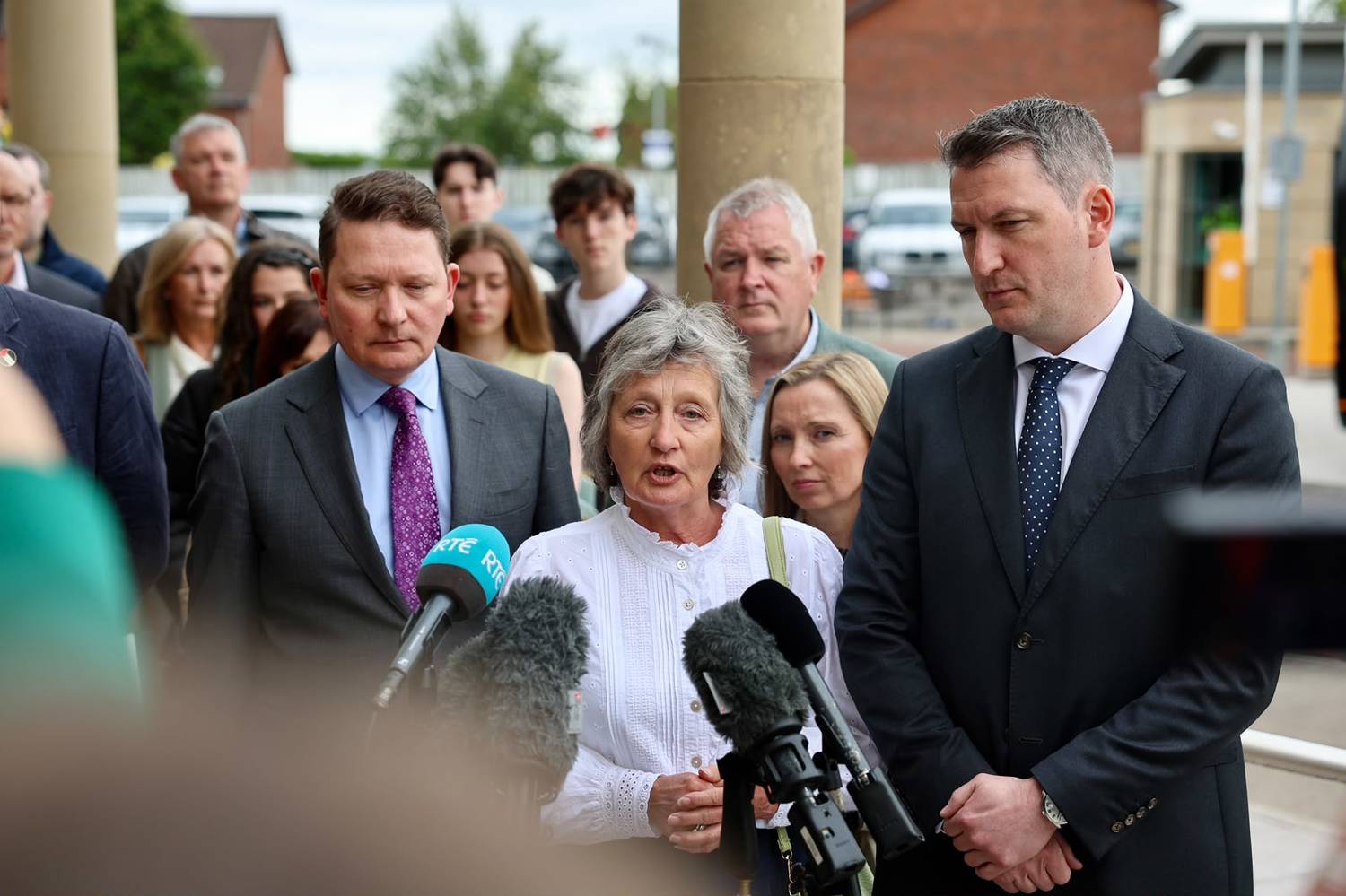
Geraldine Finucane and son John Finucane at the opening of the inquiry.
The long-awaited investigation into Pat Finucane's 1989 murder opens in Belfast on Wednesday, marking the start of a process expected to stretch over several years. Full evidential hearings are not anticipated until Spring 2027.
==
After 37 years and 118 days, the family of Pat Finucane will see their tenacious and determined legal battle finally realised with the opening of a public inquiry into the Belfast solicitor’s murder.
On Wednesday, the public inquiry into allegations of state collusion in the father-of-three’s murder in February 1989 will officially open at Bradford Court Building in Belfast.
It is more than seven years since the UK Supreme Court ruled that none of the British government’s previous five investigations into the lawyer’s murder had been Article Two compliant.
Under Article Two of the European Convention on Human Rights (ECHR) the British government has a statutory duty not to take life unlawfully, but also to conduct an effective investigation when a citizen is murdered and there is a belief that the state or its agents were involved.
Despite the Supreme Court’s landmark ruling on February 27, 2019, it took another five years, six months and 15 days before Secretary of State Hilary Benn finally announced a public inquiry into the solicitor’s murder on September 11, 2024.
While there have been five previous state reports into the UDA murder, this will be the first time in nearly 40 years that an inquiry will have the powers to compel witnesses and the disclosure of highly sensitive intelligence documents, which the Finucane family hope will finally confirm their long-held belief that key elements of the state sanctioned and facilitated the killing.
Crucially, it will be the first time that the Finucane family has been granted Core Participation Status in any state investigation.
This means that, alongside the British government, British army, MI5 and PSNI, lawyers for the Finucane family will be allowed to question witnesses and scrutinise key intelligence documents surrounding the allegations of state collusion in the murder.
Pat Finucane’s widow Geraldine and her three children are expected to attend the opening hearing on Wednesday.
However, Wednesday’s hearing is only expected to deal with inquiry chair Gary Higginbottom setting out the initial details of how the inquiry will operate.
The inquiry is expected to then adjourn until September, when it will return to determine how the disclosure of intelligence documents to the inquiry will take place.
Former Police Ombudsman Nuala O’Loan and British Crown Court judge Francesca Del Mese will act as assessors to the inquiry, although neither will sit on the panel hearings or be responsible for its final report.
An estimated three weeks has been set aside during November and December for the inquiry to hear human impact statements from 21 members of Pat Finucane’s family and colleagues.
Full hearings, involving the cross-examination of witnesses, are not expected to take place until Spring 2027.
Legal experts conservatively estimate that the inquiry could last at least four years.
Core Participation Status has already been granted to the Finucane family and various British government departments (Cabinet Office, Home Office, Northern Ireland Office MI5 and British army). The PSNI has its own separate legal representation. At least three former RUC officers have also been given partial Core Participation Status.
However, the Finucane family, represented by English barrister Danny Friedman KC, instructed by London solicitors Howe & Co, and the other Core Participant groups will not have an automatic right to cross-examine witnesses directly.
Unlike traditional criminal or civil legal cases, cross-examination of witnesses and scrutiny of documentary evidence during the public inquiry will be primarily conducted by Counsel to the Inquiry, Max Hill KC.
Instead, Mr Hill will conduct the principal questioning of witnesses and examination of documents. Core Participants, including the Finucanes, may then request permission from inquiry chair Mr Higginbottom to ask additional questions. Whether those questions are asked, and whether they are put forward directly by the family’s lawyers or put through Mr Hill, will be a matter for the chair.
Arguably, the most controversial aspect of the forthcoming inquiry will be how sensitive intelligence documents relating to Mr Finucane’s murder are allowed to be disclosed and scrutinised by the inquiry.
If the inquiry goes into closed session, because of the presence of sensitive intelligence documents, neither the Finucane family nor their legal representatives will be allowed to be present at those hearings. They will also not be allowed to know what is discussed at those secret hearings, unless it is approved by the inquiry chair.
In previous legacy cases involving the disclosure of sensitive documents in Northern Ireland, the British government has sought to use Public Interest Immunity (PII) certificates to prevent intelligence material being made public in court.
The respective judges in those cases then ruled whether a PII certificate was necessary and legitimate.
However, under the Inquiries Act 2005, a British government minister has the power to issue a Section 19 Restriction Notice, preventing witnesses and evidence from being heard by a public inquiry.
A Section 19 Restriction Notice cannot change the inquiry’s core purpose or prevent it from considering relevant evidence; instead, it can only impose restrictions on how far that evidence can be seen, heard or published, beyond the inquiry process.
An inquiry chair, who believes that a Section 19 Restriction Notice is being unfairly used to block legitimate evidence from being heard, can seek a Judicial Review to overturn the ministerial order.
It is understood that the British government has not yet indicated whether it intends to issue a Section 19 Restriction Notice.
Speaking ahead of the opening of the public inquiry into his father’s murder, John Finucane MP said:
"The opening of this Inquiry marks a significant and hard-won moment for our family after more than 37 years of campaigning for an effective and independent examination of my dad’s murder.
“For the first time, we will have a meaningful role in scrutinising the evidence and asking questions about the actions of those responsible and those who facilitated and protected them.”
Mr Finucane said that issues at the heart of the inquiry extend far beyond his own family.
“The murder of Pat Finucane was an attack on the rule of law itself, and the outcome of this process matters to many other families who continue to seek truth and accountability.
“We enter this next phase in good faith, determined to engage fully with the Inquiry and grateful to all those whose support and solidarity helped make this day possible."