 By
By
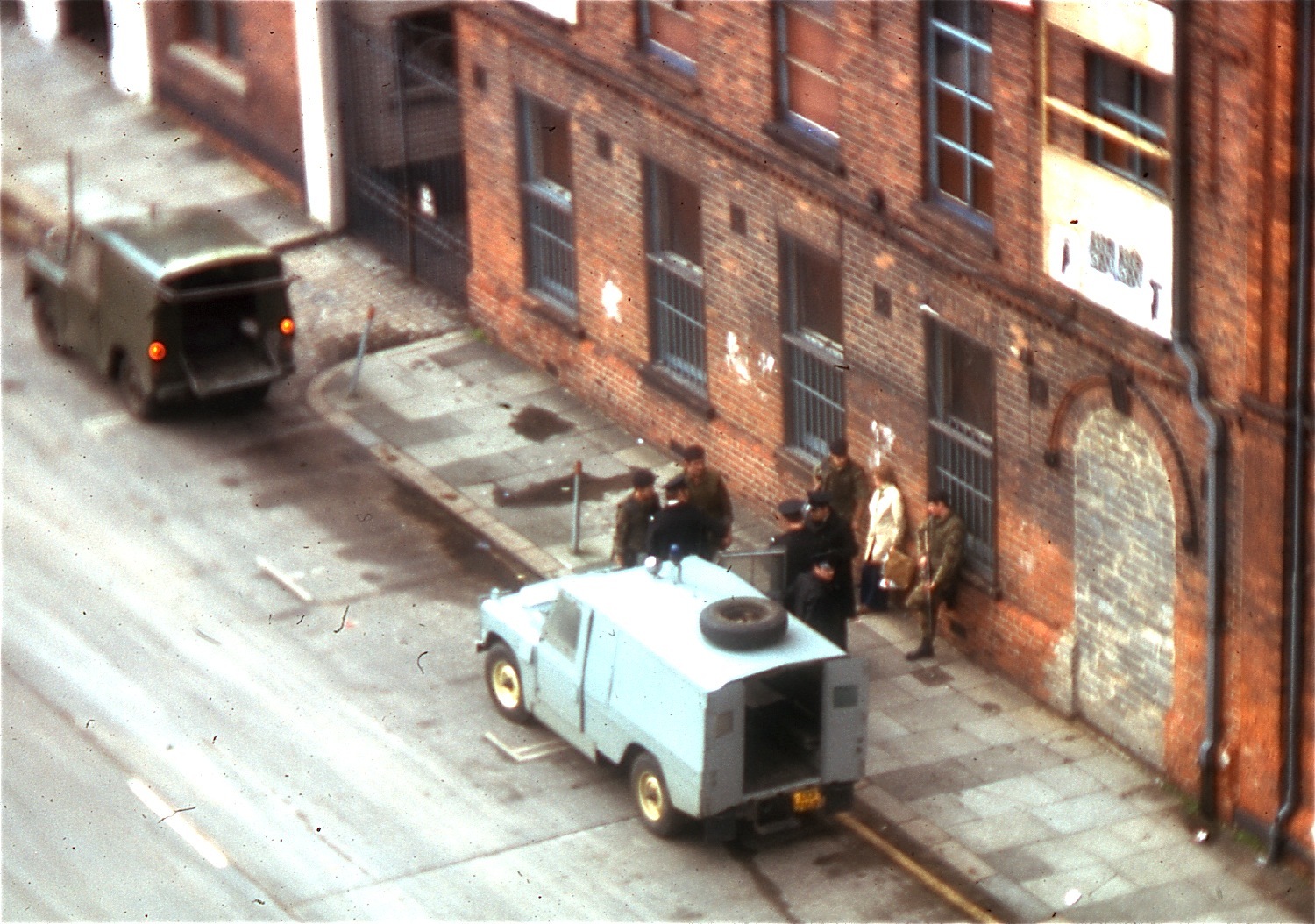
More than 1,100 families had investigations into the deaths of their loved ones shut down by the Legacy Act. A photo of British troops and police near Belfast's Europa Hotel, 1974. George Garrigues, Wikicommons.
Minutes from a secret policymaking group involved in devising the Legacy Act reveal that attendees had close ties to security services and state agencies, despite the fact the act was supposed to investigate the state’s role in many killings.
The role of policing and state agency figures in advising on the act has angered victims’ groups, who were already critical of the legislation.
The government’s previous attempt to address legacy issues, the Historical Enquiries Team, was disbanded after it was found that the agency had failed to properly investigate state killings.
Daniel Holder, from the Committee on the Administration of Justice (CAJ), spent eight months seeking the release of documents relating to the Senior Legacy Investigations Working Group, which met in mid-2020.
Mr Holder, who shared the documents marked “official secret” with The Detail, said the group “was set up behind closed doors to assist the development of what became Boris Johnson’s government’s notorious Legacy Act.”
“It is only now that some detail of the group has emerged,” he added.
Mr Holder said that the act that emerged from the meetings “led to the shutting down on the 1 May 2024 of hundreds of cases under the then existing legacy mechanisms and their disastrous replacement with the Independent Commission for Reconciliation which more than two years on is yet to complete a single case”.
Documents obtained through freedom of information requests show that the group met on 19 June and 10 July 2020. A third meeting was scheduled, but no further information has been disclosed about it.
The Legacy Act
In March 2020, Brandon Lewis, then Secretary of State for Northern Ireland, set out the Conservative government’s vision to address the legacy of The Troubles. The proposal, he said, would aim to end “the cycle of reinvestigations” by shifting the government’s focus from obtaining criminal justice outcomes for victims, to establishing how events had played out. This way the families could, in lieu of justice, obtain truth.
The new regime, Mr Lewis said, would be carried out by a single independent body which would “provide every family with a report with information concerning the death of their loved one.” The chain of events set in motion by Mr Lewis’s statement eventually led to the 2023 Legacy Act.
In June 2020, the Legacy Senior Working Group was established to get the policymaking in motion. Documents obtained after a lengthy FOI battle shed light on the group’s undisclosed attempts to develop a mechanism to address the past.
Internal Northern Ireland Office (NIO) documents for the “high-level but informal” working group stated that its purpose was to “stress test” the emerging legacy proposals and to “enable expert consideration of operational issues”.
The group was composed of senior officials from the worlds of policing, counter-terrorism, and the law, including former PSNI chief constable George Hamilton.
The only group to decline the invitation to attend was the PSNI.
One document listed suggested talking points for the NIO chair of the secret group meeting, including that he should focus on “the need to facilitate the shift away from the current criminal justice focus and towards greater reconciliation and information recovery”.
The document also underlines the government’s aim to conclude investigations of the 3,500 deaths that occurred during the Troubles “within two years”. A timeframe it acknowledged as “ambitious”.
This involved closing down the vast majority of cases within six to twelve months, with an estimated 500 deaths requiring another year of investigation.
“Following a review and, in a likely smaller number of cases, investigation, all cases will be closed and no further investigations will be possible,” the briefing note said.
On the controversial element of case closure, the note added:
“A key component of the policy package is the intention to introduce a legal bar on further criminal investigations or prosecutions as a way of providing certainty to veterans and victims and ‘unlocking’ further information recovery opportunities.”
“We recognise this will be controversial and will, almost certainly, be challenged in the courts when introduced. However, we believe that without it the litigious cycle which has come to define legacy will continue in perpetuity and efforts to move towards wider social reconciliation will continue to stall.”
While the purpose of the group was to ‘stress-test’ the legacy proposals, there were limits. A note for the NIO chair stated: “You may also wish to flag that our working assumption is that this process is Article Two compliant and as such we should work on the basis that this process would be compliant (and not discuss compliance in detail).”
Attendees
A cause for concern for campaigners arising from the disclosure will be the prominent role played by individuals linked to the security services in the group.
Madeleine Alessandri was appointed Permanent Secretary for the NIO in January 2020 and remained in post until June 2023, by which time the act was making its way through parliament. Before and after her appointment, she held a number of posts within the United Kingdom’s national intelligence infrastructure.
Until 2020, she was the UK Deputy National Security Advisor, the central adviser to the prime minister and cabinet on security and responsible for coordinating intelligence between agencies such as MI5 and the government. After leaving the NIO, Ms Alessandri became Chair of the Joint Intelligence Committee (JIC), a senior Cabinet Office body.
Other attendees include Chloe Squire, who was the Director of National Security at the Home Office at the time of the meeting. Shehzad Charania MBE, then Director of the Attorney General’s Office, now works for GCHQ, the UK’s intelligence, cyber and security agency.
Daniel Holder from the Committee on the Administration of Justice noted that “Despite the legal duties to ensure effective and independent investigations into legacy cases, which clearly include those involving the security forces, the group itself tasked with advising on how the policy should be developed heavily involves policing and security figures."
The Minutes
Minutes from the meeting, which are labelled “Official Secret” and “not for circulation to membership” show discussions ranging from the nuts and bolts of logistics of any future legislation, to suggestions about using the Iraq Historic Allegations Team as a comparator for any effort to address the past.
Although much of the discussion echoed Mr Lewis’s ministerial statement there was also a good deal of debate, with attendees questioning the legality of the Conservative’s approach, including a warning of the “vast” legal risk it poses.
The government’s plan, the minutes show, was to process cases quickly, closing them down where it's “clear securing a criminal justice outcome isn’t possible”, and instead moving these families onto “the information recovery phase.”
Kelby Harmes, Head of the Attorney General’s Office, agreed with the government’s approach and pointed to “a similar process in New Zealand with the ‘indigenous community”.
Chris Flatt from the NIO noted that the most recent case was 22 years old, and the proposed model which “rule out the cases who don't stand any prospect of a judicial outcome”.
He said they needed to adopt a process that stayed within the law but allowed them to “cut through the cases as quickly as we can”.
The government was doing this, Mr Flatt said, so that they could “reach out to former paramilitaries who will tell the Legacy Commission what happened without the threat of imprisonment.” However, he cautioned: “We do not want to present this as an amnesty.”
Madeleine Alessandri, as chair of the meeting, set out why addressing the past was vital “for allowing Northern Ireland to move forward as a society and transition fully into a post-conflict society.” She accepted that concerns had emerged about the government’s approach to the past.
Dean Haydon, the then-Deputy Assistant Commissioner at the Met, advised that “legal risks are vast” around triage and jurisdiction in this area and would require “significant” resources as there would “undoubtedly be legal challenges.”
The concerns around closing down cases were echoed by multiple attendees.
Former Chief Constable George Hamilton warned the proposals were unpopular in Northern Ireland
The former head of the PSNI also questioned whether the minister's proposals could “really be achieved within the current legal framework” and questioned how they could move beyond pursuing criminal justice without derogating from the European Convention on Human Rights and that it “is not credible to maintain these proposals are consistent with the Stormont House agreement.”
Mr Hamilton also claimed that “even when you secure a criminal justice outcome, experience has shown that it doesn’t bring the closure people hope for or bring family satisfaction.”
“Families will welcome information recovery. It is the small vocal minority that will present the legal challenges and we should be ready for that but they do not speak for the silent majority who just want to move on,” he added.
In response to Mr Hamilton’s comments, Mark Thompson of Relatives for Justice, told The Detail, “I wouldn’t describe the 1,100 bereaved relatives of murder victims including victims of torture who want answers as 'small and vocal minority’”, he said, referring to the number of civil cases lodged by bereaved families when the Legacy Act was introduced.
Mr Thompson added: “It is not lost on all these families that the very people who made these comments represent the very same state agencies that would be subject to robust independent investigations with full accountability if we were to have such a process.” Their task, Thompson argued, “is to prevent such a scenario.”
In a response to The Detail, Mr Hamilton said he agreed to be part of the working group “to ensure the lessons of previous attempts at dealing with legacy investigations were understood and to ensure learnings were not lost in the drafting of any new proposals.”
He said that he couldn’t "confirm that any of the comments attributed to me were accurately recorded” and was “unaware of the NIO’s rationale in withholding minutes from those present” and that the minutes did not reflect all his comments, including how strongly he advocated for an Operation Kenova model of legacy investigations.
In addition, he said believed NIO closed down the working group early “because of the level of challenge that was coming from representatives from policing and this was not in keeping with the NIO’s desire to create a model that would close a large number of cases down as rapidly as possible."
At a follow-up meeting on 10 July, the group got into the nuts and bolts of how the policy would work. The meeting minutes concluded that it would be possible to investigate all 3,500 Troubles-related cases which occurred in the UK in “an efficient and human rights compliant manner.”
George Hamilton stated that work previously done by the Historical Enquiries Team would give “a head start” but that all cases “would need to be looked at afresh to ensure Article 2 compliance”.
The group discussed other logistical aspects, including “a social media handling strategy” that would “be required given high levels of political interest” as well as the finances that would be required, noting that the government had committed £30m for five years under the Stormont House agreement.
When queried about the group, a Northern Ireland Office spokesperson said:
"This relates to a group that was established to discuss issues relating to the development of the previous Government's Legacy Act, which this Government is repealing and replacing.
“The Northern Ireland Troubles Bill will enable victims and bereaved families across the UK to seek information and accountability through a reformed Legacy Commission. The Bill will ensure nobody receives immunity for Troubles-era crimes, and will enable information sharing by the Irish authorities, while putting in place lawful safeguards for our former service personnel."
The NIO was asked why it did not disclose the minutes for the third, planned meeting that was mentioned in the minutes, or if the meeting took place, but gave no response.