 By
By
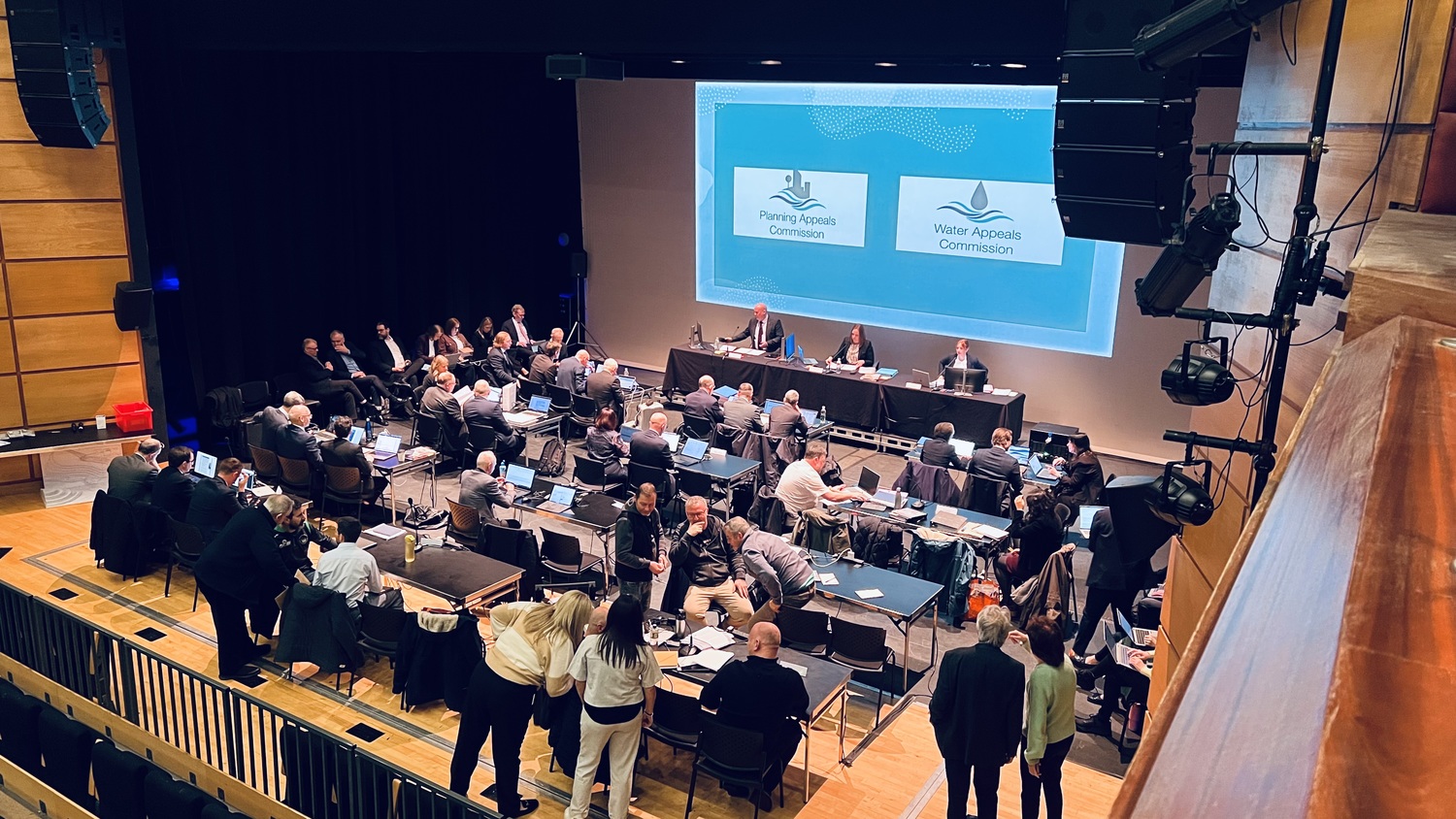
The public inquiry resumed this week after collapsing last year. Photo by Shauna Corr
Cyanide is still referenced in Dalradian Gold’s application to mine in Northern Ireland despite assurances the toxin will not be used to process ore on site, a public inquiry has heard.
The inquiry examining the most opposed planning application in Northern Irish history resumed this week after collapsing last year.
The formerly Canadian firm's bid to mine in the Sperrin Mountains is being examined by the Planning Appeals Commission after 50,000 objections to the project.
Commissioner Jacqueline McParland raised the issue of cyanide on behalf of third parties during the second day of the reconvened hearing in Omagh on Tuesday.
It arose after long debate about vague tallies of the volume of chemicals to be used in extracting minerals from the ore mined on site before it is made into a concentrate of different metals to be sold on.
Cyanide is commonly used in gold mining in the extraction process, but can have substantial environmental impacts and public health risks if released into the environment
Dalradian Gold said in 2019 it would not use cyanide to remove gold from the ore it originally planned to process on site because of public concerns.
But Ms McParland told the inquiry she had “reviewed the waste plans” and that “there remains cyanide in part of the process”.
She also highlighted references to it in the risk table and elsewhere, adding “there are concerns it will be reintroduced” after planning permission through amended conditions.
Save Our Sperrins member Fidelma O’Kane told how counsel for the US-owned company assured the Planning Appeals Commission they would be removed last year.
Amid doubts sparked by its continued inclusion, Ms McParland asked the Department for Infrastructure (DfI) if it is satisfied cyanide has been removed from the process.
Daniel Elvin KC said on behalf of DfI: “Our assumption is that it has been removed… we took that at face value.”
He added that any variation “in all likelihood would require a new up to date environmental statement”, that it cannot be brought back in and would need further consent.
Speaking for Dalradian, Stewart Beattie KC, apologised “that it’s there” and said it “can be removed or conditioned”. Both parties were asked to return on Wednesday with proposed “conditions on removing references to cyanide by tomorrow morning.”
Third parties raised concerns DfI had simply taken Dalradian at their word given previous enforcement cases against them for not restoring the site, pollution incidents and 8,500 tonnes of infill that was added to the site - allegedly without planning permission.
Former Fermanagh and Omagh District Councillor, Emmett McAleer, said he was “very concerned” after a “representative for DfI… [said] we took that at face value after skimming through a non-technical report”.
“It’s a summation and a much less detailed summary of a technical report. To think that departments charged with looking after this could be going through a non-technical report or taking something this company says at face value - frankly that’s terrifying.
“Is this widespread through departments if they are not reading documentation? What are we dealing with?” he asked.
Third party representative, Paul Haughey, also accused DfI of giving Dalradian "preferential treatment.”
Following agreement from third parties, the proposed condition ruling out any use of cyanide on site will be discussed on Wednesday.
The values of chemicals still to be used also led to serious debate, with the table outlining volumes described as vague.
‘Worst case scenario’
Fermanagh and Omagh council’s legal representative, Conor Fegan, outlined how they showed “approximate usage” and that “a maximum figure” was what is needed “to ensure that any consent would be set with the reasonable worst case scenario parameters.”
Third party representative Bill Donnelly questioned where the metal concentrate would be sent for further processing, outlining how Cavancaw mine just a few miles away had historic consent to use cyanide without an environmental impact assessment.
He said: “I can envisage ore from this mine being processed at Cavancaw - there is nothing in the Cavancaw permission that they can’t process ore from elsewhere."
It remains unclear where the metal concentrate is going.
Ms McParland struggled to make headway on her list of 53 questions, with accusations of preferential treatment towards some speakers and “cutting off” others.
NGOs, activists and community campaigners also raised concerns about who was allowed to speak as some groups were advised they could not address the room because they hadn’t submitted certain documents.
Ongoing changes to Dalradian’s planning application was also an area of contention.
The 2017 planning application has had a number of addendums through the years, but is still being judged by 2015 planning regulations around environmental impact assessments.
DfI insisted a Strategic Environmental Assessment is not needed, despite it being considered a regionally significant application that will be assessed by a Minister and not the local planning authority.
On the issue of project splitting, with eight separate applications being submitted for one project, civil society and officials also failed to see eye to eye.
Ecologist Dr Mark Ruddock told how the use of different methodologies and survey boundaries in the eight applications could be seen as “project splitting” as it was leading to the overcomplication and making it very difficult to assess the overall impact.
The official line was that every application from water discharges to electricity connections are dealt with by different legislation, so it made sense to approach the project in this way. It was also argued that the environmental impacts of the projects were also being considered.
Campaigners are still concerned the inquiry, being heard over 20 intermittent days up to June, is not being broadcast live to facilitate those who can’t attend in person.
Following concerns some sections may run on, discussions were also held around extending the inquiry times some evenings to ensure every topic is discussed.
The inquiry continues.
Shauna Corr is an investigative reporter