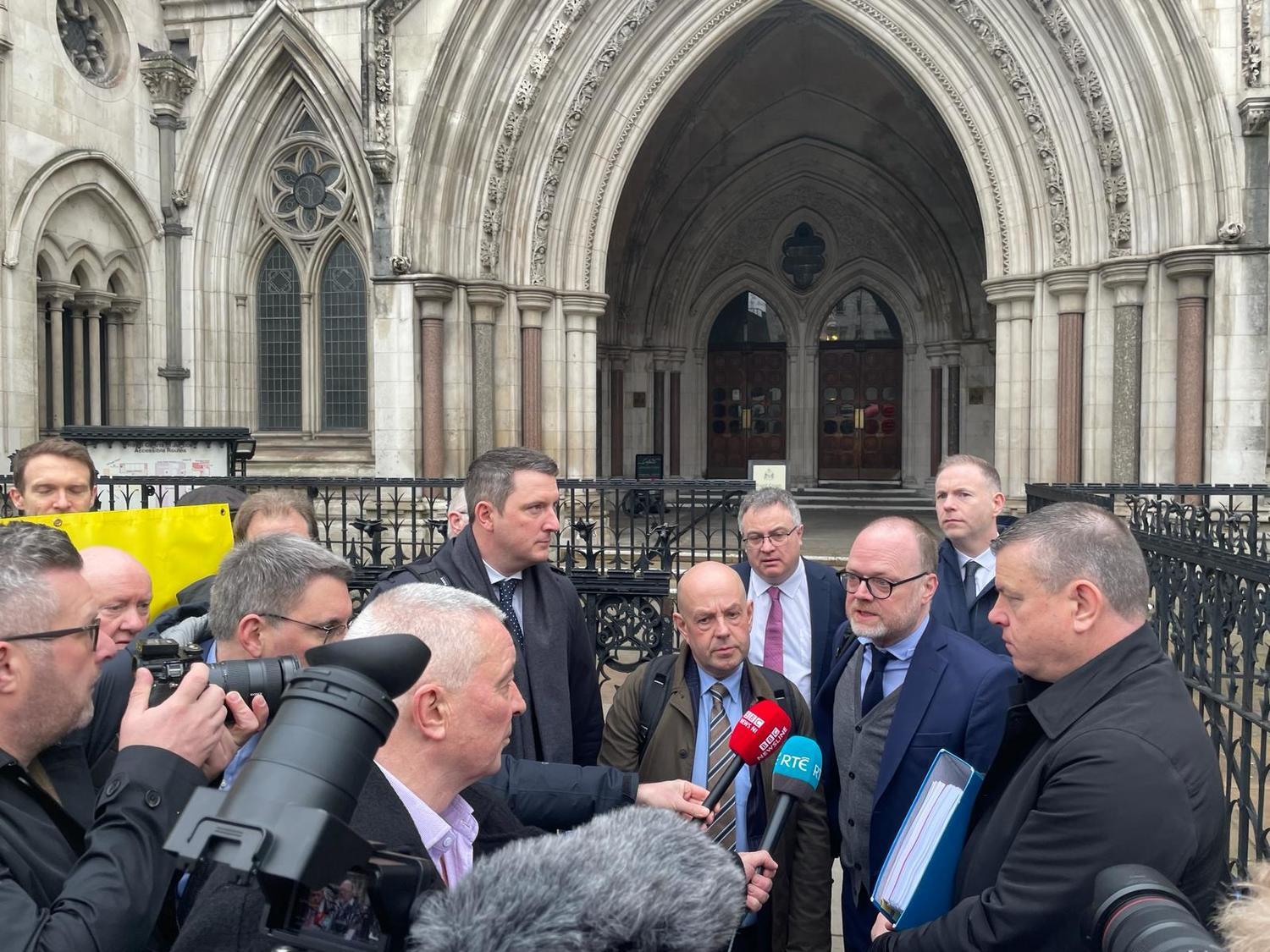
Barry McCaffrey (left) and Trevor Birney outside the Investigatory Powers Tribunal in London in 2024. Photo courtesy of Sarah Kavanagh
Two Belfast journalists who were placed under unlawful surveillance have expressed “deep disappointment” at a Court of Appeal ruling that the PSNI cannot be punished for wasting court time and legal costs after repeatedly supplying “late and inadequate disclosure of evidence” which led to a series of court hearings being “severely disrupted and delayed.”
Earlier this month journalists Trevor Birney and Barry McCaffrey took a case to the Court of Appeal in London challenging an Investigatory Powers Tribunal (IPT) ruling that it has no powers to sanction the PSNI for its “unreasonable conduct" in delaying the court hearings.
The IPT had previously ruled it had no legal jurisdiction to order the PSNI to pay the wasted legal costs of two IPT hearings in February and May 2024, despite finding that those proceedings had been severely disrupted, delayed, and rendered ineffective due to the PSNI’s late and inadequate disclosure of evidence.
Rejecting the journalists’ case yesterday, Court of Appeal judge, Lord Justice Bean agreed that the original tribunal hearings had been “dogged by late and inadequate disclosure by the PSNI”, resulting in the two separate hearings having to be postponed shortly before they were due to take place.
The Court of Appeal further noted that five IPT judges had strongly agreed there was a clear need for the Tribunal to have powers to award costs—particularly against respondents where expenditure is wasted due to the PSNI’s conduct or persistent breaches of tribunal orders.
However, the Court of Appeal agreed with the IPT that it had no power to act, leaving any expansion of its powers as a matter for the government.
Responding to the Court of Appeal judgment, the journalists said that the ruling exposes an unfair bias in favour of police and state intelligence agencies and highlights a serious legal loophole in proper and fair accountability.
"This interpretation means that public authorities can obstruct, delay, and breach tribunal orders with financial impunity,” said Trevor Birney. “The IPT itself described this lack of power as an unsatisfactory outcome. It cannot be right that state agencies can waste public funds and frustrate the course of justice without facing consequences."
Insisting that the journalists would continue their legal fight for proper accountability of state wrongdoing, Barry McCaffrey said:
"This case began because our homes were unlawfully searched to protect state secrets and expose our confidential sources. We proved the PSNI acted unlawfully. This ruling confirms a procedural flaw in the legal system, and we firmly echo the court's view that the rules need to be changed to prevent this kind of misbehaviour in the future.”