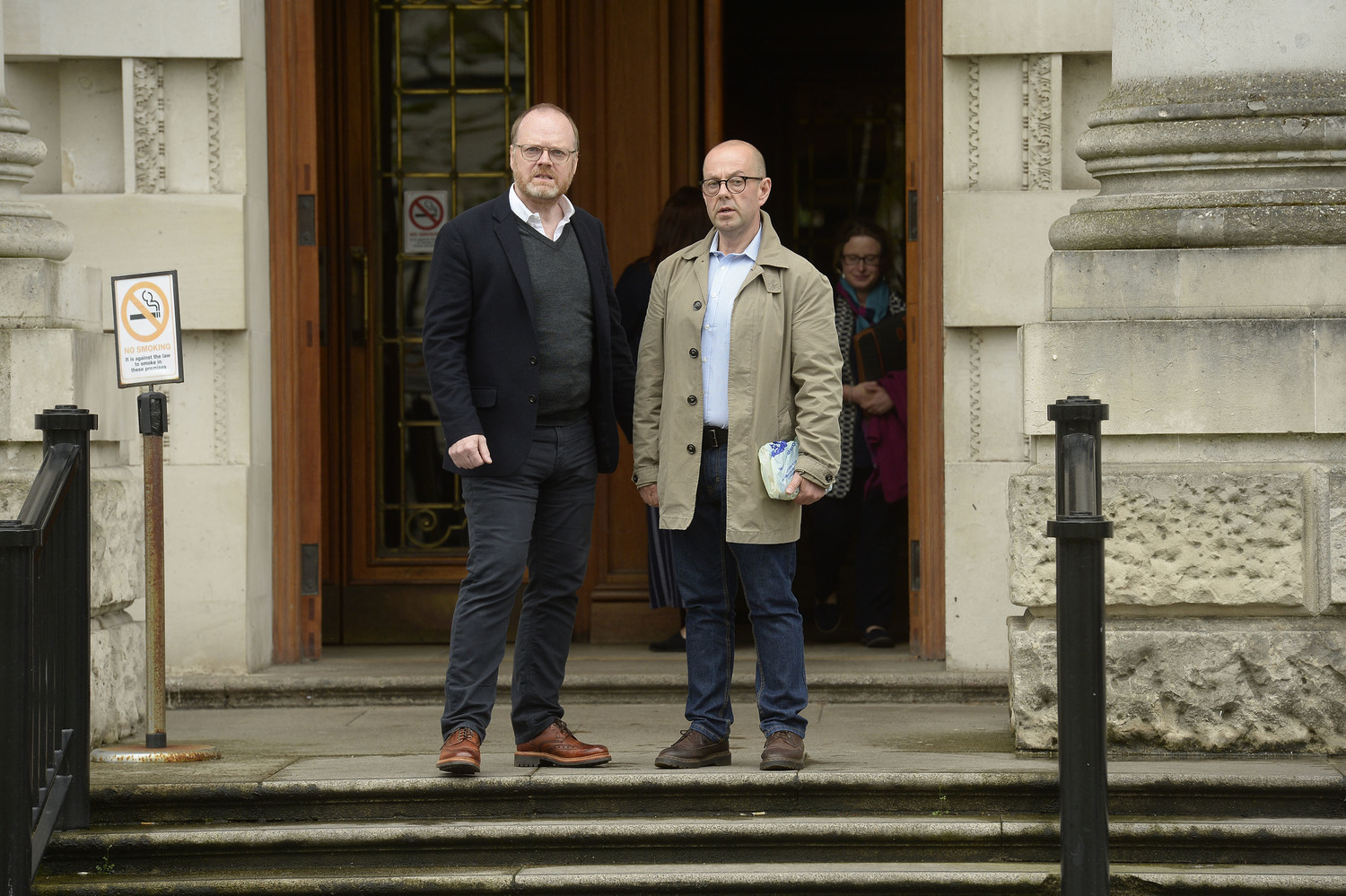
Trevor Birney and Barry McCaffrey outside the High Court in Belfast in 2019. Photo by Stephen Hamilton, Press Eye
Two prominent journalists, Trevor Birney and Barry McCaffrey, are advising fellow media professionals not to accept any offers of personal meetings with PSNI Chief Constable Jon Boutcher regarding PSNI spying operations against them.
Their warning follows the latest revelations that the PSNI spied on former BBC journalists Barney Rowan and Vincent Kearney in 2006. Rowan, a former BBC security editor, had his phone monitored by the PSNI after writing a story on the killing of Denis Donaldson in April 2006.
Donaldson was a police and MI5 agent within Sinn Féin.
Boutcher has now offered to meet Rowan in person. “I am happy to meet with him to discuss any issues or concerns he may have,” he told the BBC.
However, Trevor Birney and Barry McCaffrey, the journalists whose legal case first exposed the PSNI spying operation against journalists, have warned reporters from taking up the chief constable’s offer of informal briefings on their individual cases.
“We believe that these offers from the chief constable are a deliberate and cynical attempt to thwart any proper independent scrutiny of the PSNI spying operation against journalists,” said Birney.
The two reporters pointed to a report, commissioned by the chief constable in 2024, in which English barrister Angus McCullough KC was asked to investigate PSNI surveillance of journalists.
“From the very outset of the McCullough Review we questioned why it was only allowed to investigate cases from 2011 to 2023,” McCaffrey explained.
“We repeatedly urged that Angus McCullough be allowed to investigate surveillance against journalists from the formation of the PSNI in 2001 unto the present day.
“We were told by McCullough and others that the chief constable was adamant that the investigation into spying on journalists could not go back prior to 2011.
“We were told this was purely about value for money and nothing else.
“The latest evidence that at least two other journalists were being spied on in 2006 shows that those assurances were false.
“We believe the McCullough review and the Policing Board were deliberately misled by the PSNI to prevent any proper investigation into spying against journalists prior to 2011.
“It is now clear that Angus McCullough was only allowed to investigate a fraction of the spying that went on against journalists. What possible benefit to public confidence in policing is that?”
By December 2025 the McCullough review had cost £750,000. The barrister is expected to produce further findings next year, but will not be allowed to investigate any PSNI spying against journalists prior to 2011.
Mr Birney further questioned the chief constable’s claims that there is no evidence that the PSNI has continued spying on journalists since 2015.
“It is crystal clear from our case that Barry McCaffrey and myself were under unlawful PSNI surveillance in August 2018. Disclosure in our legal case also showed that PSNI monitored the mobile phone of one BBC Spotlight journalist in March 2022.
“In 2024 the PSNI confirmed that monitoring of journalist calls had only been suspended in March 2023 when our legal case became public knowledge. So, for Jon Boutcher to claim that no journalist was being spied on after 2015 is simply untrue.”
Advising any journalist against accepting any PSNI offer of informal briefings, McCaffrey said:
“Any reporter who is prepared to accept any informal assurance from Jon Boutcher that everything is fine and there is nothing to worry about is doing a major disservice to the journalistic profession.
“Only a proper, independent, judge-led inquiry into PSNI and security services surveillance against journalists is acceptable. That is the only thing that will restore the serious damage which the PSNI and security services has already done to public confidence in policing.
“Mr Boutcher’s offers of informal chats with individual journalists is an insult to our profession and no self-respecting journalist should accept any such offer.”