 By
By
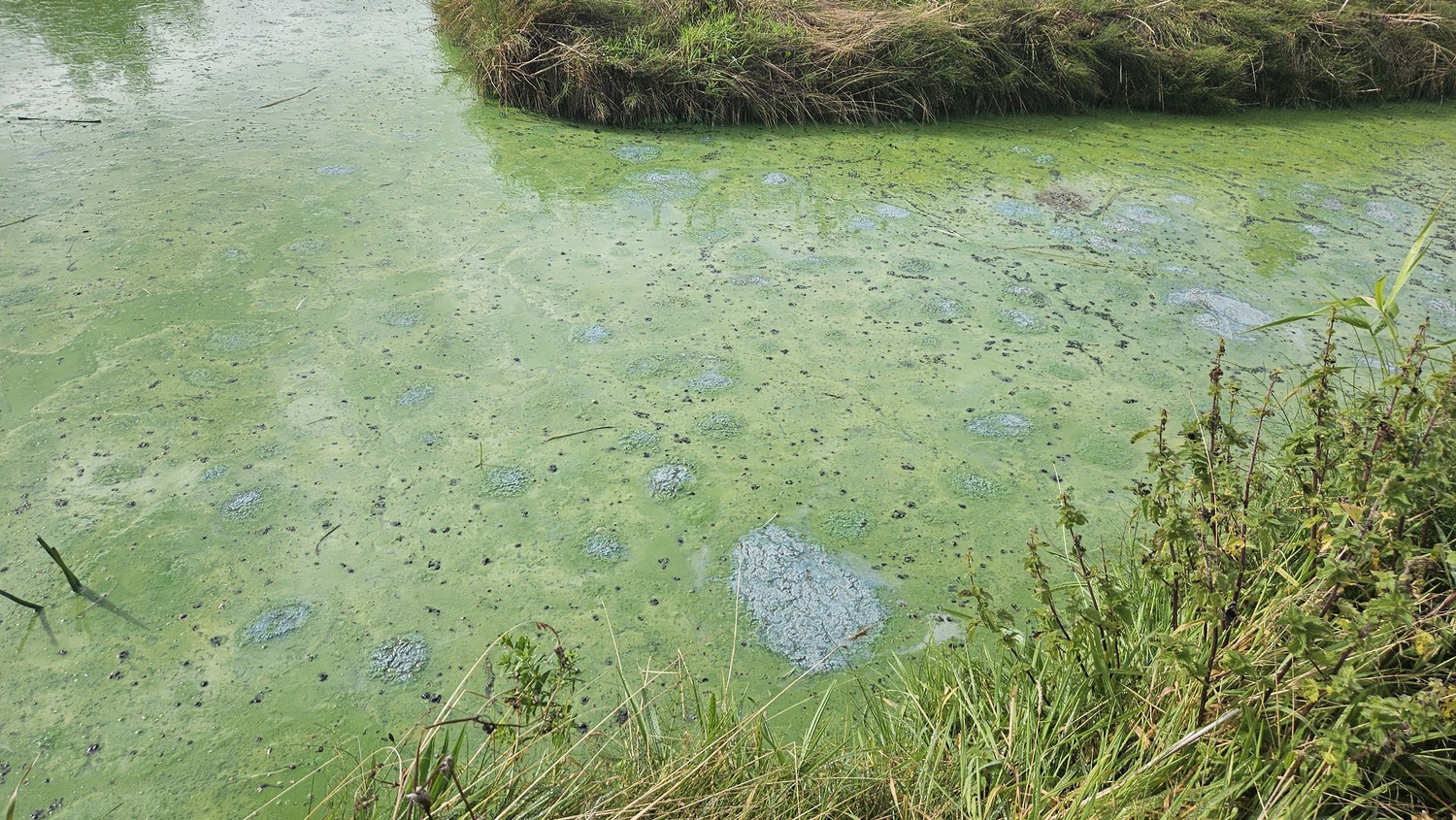
Blue green algae at an Ardboe quay last September.
The Lough Neagh Partnership (LNP) recommended that stakeholders enter negotiations over the future ownership of Lough Neagh before carrying out fundamental legal and financial due diligence.
Internal correspondence obtained by The Detail shows that the LNP proposed local stakeholders enter talks with the Earl over the lough bed transfer before doing exploratory “due diligence” work.
This work would include basic research into what costs and risks there might be, as well as what would be entailed in terms of the land registry and deeds regularisation, among other legal concerns.
The disclosures come as Lough Neagh faces the prospect of a fourth consecutive summer of severe blue-green algal blooms and as the campaign for the next Assembly election – now less than a year away – is expected to intensify.
The Earl is due to address a conference in Belfast later this week, entitled ‘Saving Irish Lakes’, which majors on the continuing environmental and public health crisis at Lough Neagh. Gerry Darby, the LNP’s manager, is also due to speak at the event.
The non-profit body, which is partially funded by the Shaftesbury Estate and includes representatives linked to the sand dredging industry on its board, suggested talks on a transfer of the lough bed should begin before key questions around ownership, costs and legal liabilities had been examined.
Emails from February 2025 reveal the LNP suggested commissioning this work “only at the appropriate stage”, which it defined as “when the transferee [the Earl] is ready to proceed with the transfer of ownership”. The Partnership argued that such an approach would be “prudent”.
The Detail understands much of the LNP's funding comes from DAERA – at least £5-6 million between 2009 and 2022/23, plus roughly £470,000 between 2024 and 2025, although the LNP did not specify how much this accounted for overall when asked by The Detail.
The Shaftesbury Estate told The Detail in 2025 it had committed £12,000 to the Partnership over the preceding two years, along with “a significantly greater sum over the next three years”, which it did not disclose.
A representative of the Estate sits on the LNP board, alongside a senior figure associated with sand and construction companies licensed to operate on Lough Neagh. Other board members include a number of councillors, plus representatives from some community groups and government agencies.
An initial piece of due diligence work was later carried out by the Lough Neagh Development Trust (LNDT). The LNP contracted the LNDT to undertake this work via a Single Action Tender, where a contract is awarded to a contractor without a competition.
Over the second half of 2025, the LNDT produced a report which looked at legal frameworks for community ownership models. The report also scoped out some new ownership options and any due diligence questions that such a transfer of the lough’s bed, banks and soil might raise.
In the report’s executive summary section, it found: “There is broad cross-sector agreement that current governance arrangements are insufficient to address Lough Neagh’s ecological crisis.”
According to the report, those surveyed by the LNDT supported “reform grounded in: Democratic accountability; Stronger enforcement; Legal innovation (including Rights of Nature); Sustainable funding; Multi-sector collaboration.”
But, the report warned, “ownership transfer is legally complex, financially demanding, and institutionally sensitive. It must be accompanied by: Robust due diligence; Clear statutory backing; Long-term funding strategies; Carefully designed governance mechanisms.”
The LNDT’s exercise considered a range of vehicles for the proposed transfer, as well as a number of case studies, including one on Scotland’s Isle of Lewis and two in England.
It highlighted: “If structured effectively, a community-led ownership model could reposition Lough Neagh from a fragmented, extractive asset to a democratically governed environmental commons capable of long-term restoration and regional regeneration.”
The report also stated: “Full due diligence is estimated to require a minimum of nine months and would likely require parallel valuation and accounting assessments.”
“Going in completely blind”
In the email correspondence with a Heritage Fund investment manager, the LNP describes the due diligence project – for which £10,000 was allocated – as “significant” and “complex”.
A spokesperson for the Heritage Fund told The Detail it was “satisfied” that the LNP’s overall project requirements had been met.
The spokesperson said: "The Lough Neagh Partnership made an application to The National Lottery Heritage Fund for The Lough Neagh Ownership and Heritage Resilience Project and were awarded funding totalling £224,395 in July 2023.
“We are satisfied that project activities have been delivered."
But the suggestion that due diligence over any proposed lough transfer should be left to a late stage raises important questions, according to one senior Belfast researcher.
John Barry, a professor of green political economy at Queen’s University Belfast, questioned why the LNP proposed delaying this foundational due diligence work.
Professor Barry argued that recommending local stakeholders – whether a community group or a government-aligned organisation – enter talks with the Shaftesbury Estate without having done necessary research would be akin to entering them ‘blind’.
He said: "Whatever the constituted non-Shaftesbury body is that's negotiating with the Earl of Shaftesbury, they'd be going in completely blind.
“And they're already at a disadvantage because, if they're a community group, they're already massively outgunned in terms of resources, legal expertise and all the rest of it."
A spokesperson for the Earl and Shaftesbury Estate said they declined to comment when approached. The LNP did not respond after multiple requests for comment.